

Agentic Customer Success: I Built the Operator, Then Put Our Own Agent Inside It
“The teams that win the next two years will not be the ones with the best health score model. They will be the ones whose product does the onboarding, whose users become champions in week one rather than month nine, and whose CS org spends its attention on judgment instead of assembly.”
 Tamar Weissblueth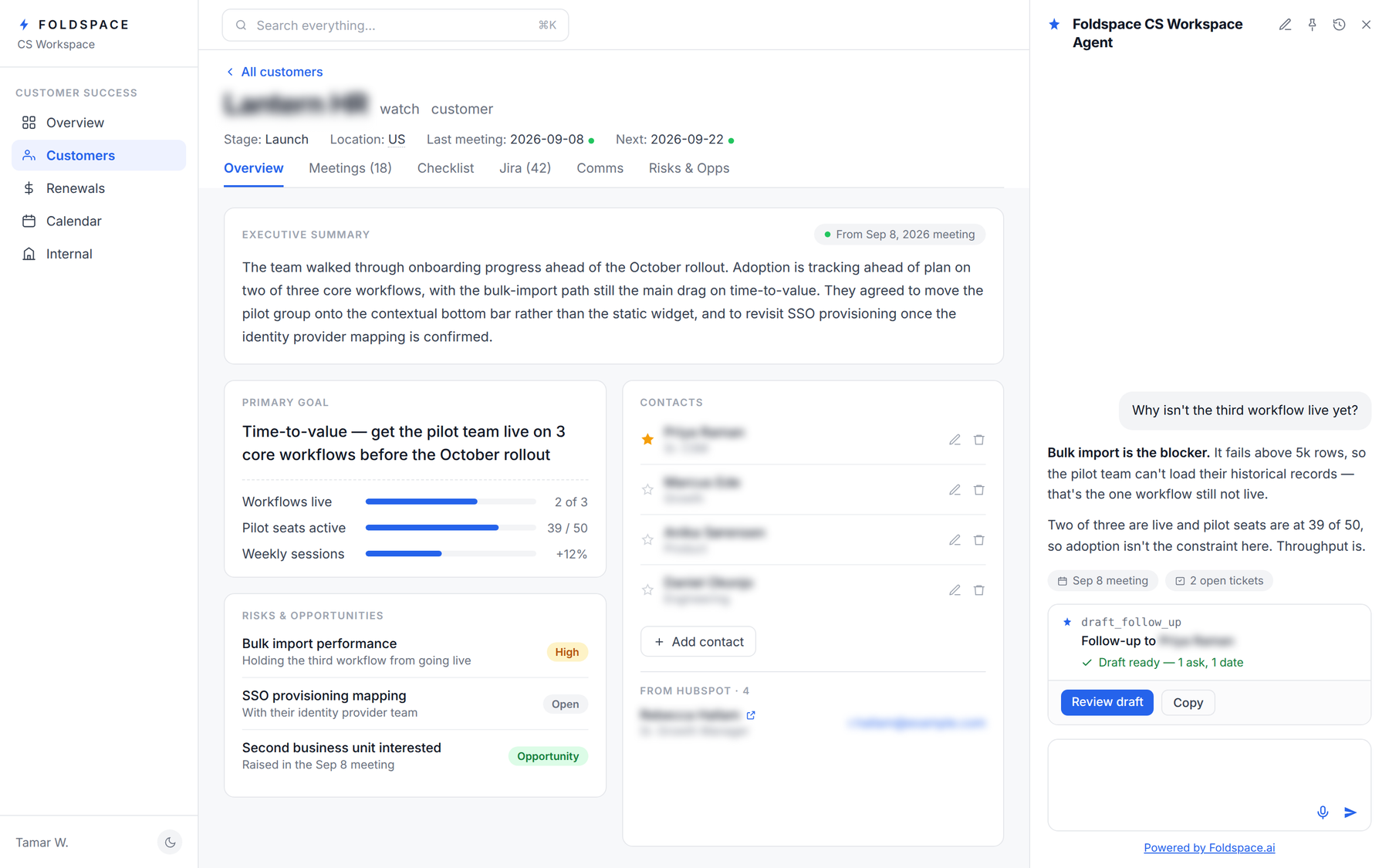
I do not run Customer Success out of a CS platform. I run it out of an application I built, with our own agent installed inside it, and most mornings I start by asking it what is slipping this week.
Digital customer success, as most of us inherited it, is a reporting layer: health scores, usage rollups, a QBR deck assembled from last month's data. It scaled how we talk to customers and never scaled the work. A dashboard can tell you an account looked fine on Tuesday. It cannot tell you what a user tried to do and failed to do, and it has no hands.
So I stopped maintaining one. I rebuilt the account dashboard I inherited into a live application and installed our Product Agent inside it. I call it Agentic Success.
Its best signal does not come from my CRM. It comes from our customers' users, talking to an agent inside their own products, telling us in their own words what they were trying to get done.
What it watches
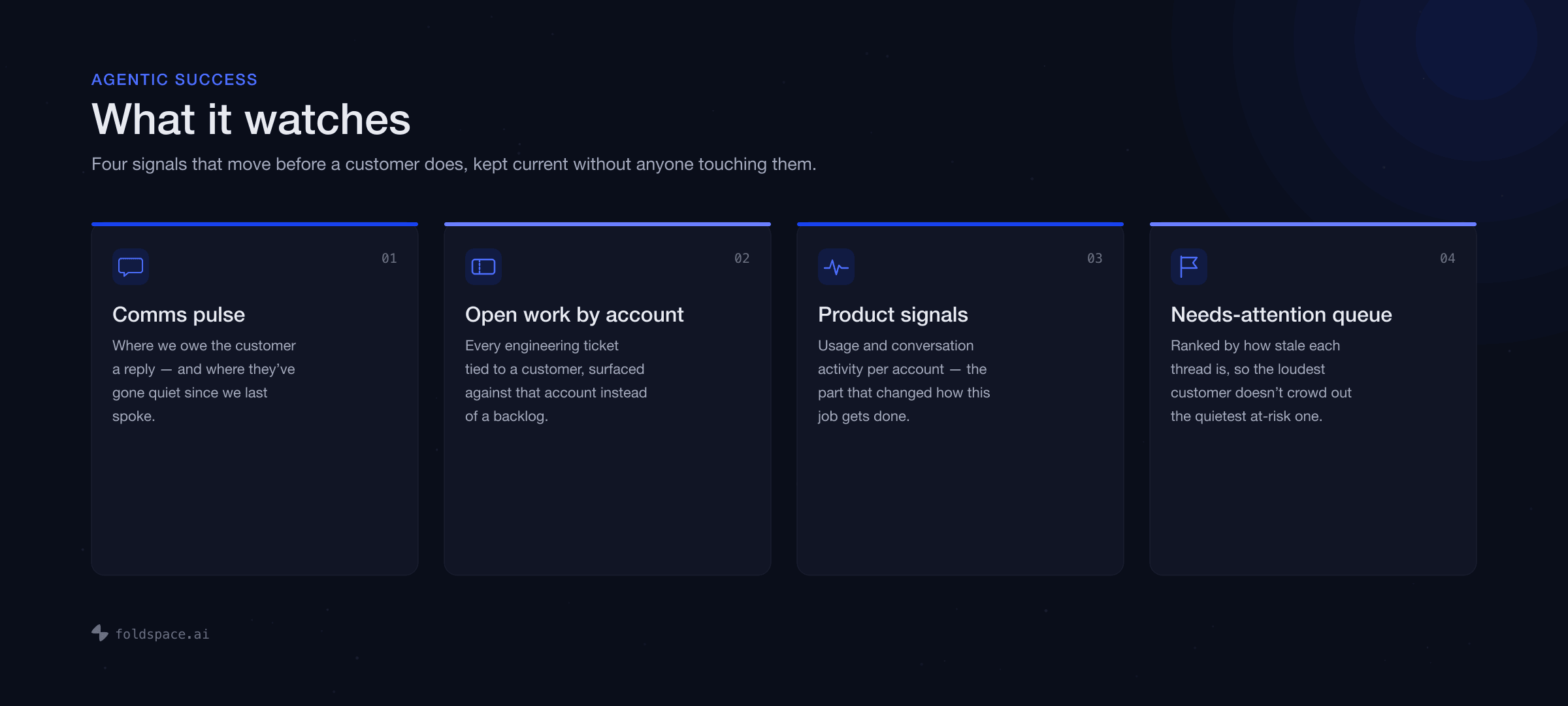
The build was an argument about attention. Not more data on a screen, but the four signals that actually move before a customer does, kept current without me touching them.
- Comms pulse, in both directions. Where we owe the customer a reply, and separately, where the customer has gone quiet since we last spoke. That second one is the pattern behind silent churn, and every tool I have used averages it into an engagement number where it disappears. It gets its own view.
- Open work by account. Every engineering ticket tied to a customer, surfaced against that customer instead of sitting in a backlog nobody in CS reads.
- Product signals per account, which I will come back to, because they are the part that changed how I do this job.
- A needs-attention queue, ranked across accounts by how stale each thread is, so the loudest customer does not crowd out the quietest at-risk one.
It syncs on its own. When I open it, I am looking at today.
Then I put our agent inside it
Our customers embed the Foldspace Product Agent into their software so their users can get things done by asking. I embedded the same thing in the tool I run my accounts from.
Today it makes the app conversational. I ask what is slipping this week instead of reading four views and assembling the answer myself. The next layer is Actions, the workflows the agent executes rather than describes, and I am wiring the first three now: summarize an account's status from live engagement, open tickets, and comms in one read. Draft the outreach to the account that went quiet, straight off the silence signal. Show me who needs attention this week and why each one made the list.
When those land, the app stops being something I read and becomes something I operate by talking to it. I state the goal. The agent does the work.
That is not a side project. It is the same promise we make to our customers' users, pointed at my own job, which is the only honest way to find out whether it holds.
The signal comes from our customers' users, not from my CRM
This is where the two halves of my job turned out to be one system.
The agent our customers install is doing their onboarding. A user states what they want, and the agent carries it out inside the live product, grounded in that product's real capabilities. Setup that used to be a thirty-click path through screens a new user has never seen collapses into a sentence. That is what the customer bought it for.
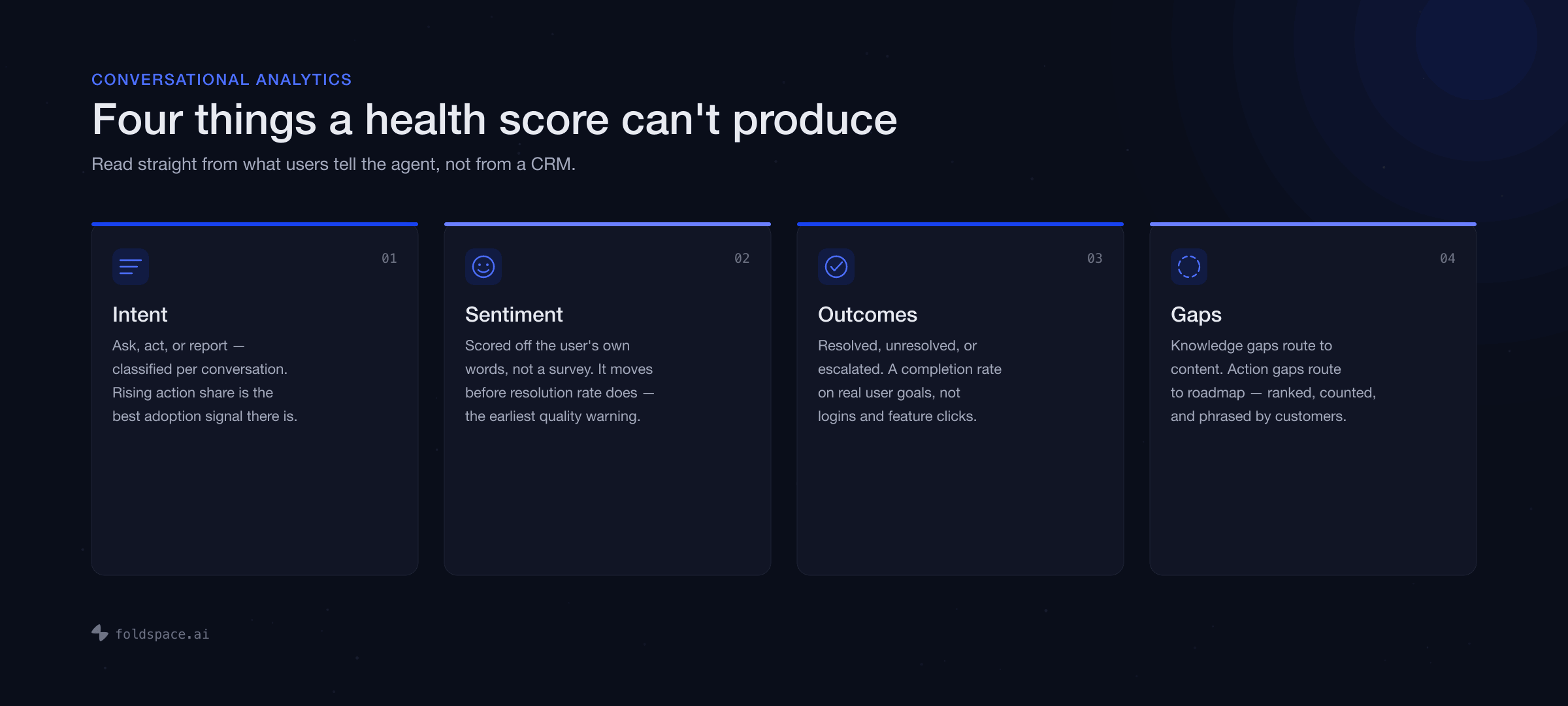
But the same agent is also the instrument. Every one of those requests is a user telling us, in their own words, at the moment of need, what they were trying to accomplish. Our Conversational Analytics reads them, and four things come out that no health score can produce.
- Intent, classified per conversation: asking for information, asking the agent to do something, or reporting a problem. A rising share of action requests means users are handing over more real work, the best adoption signal I have ever had. A rising share of reported issues means I have a product problem, and I know within days rather than at the next QBR.
- Sentiment, read off the conversation itself. Not a survey. Every conversation is scored on tone from the user's own messages, and I can slice it by account, segment, or time range. Negative share moves before resolution rate does, which makes it the earliest quality warning I get. When it moves, I filter to those conversations and watch what happened on screen.
- Outcomes. Whether each conversation resolved, went unresolved, or escalated to a human. A completion rate on real user goals is a different measurement from logins and feature clicks. It tells me whether the product delivered value, not whether someone showed up.
- Gaps, in two kinds. When the agent cannot complete something, it lands as a knowledge gap, where the information was missing, or an action gap, where the capability does not exist yet. Those route to two different teams. Knowledge gaps are a reading list for content I own. Action gaps are ranked demand for capability we do not have, phrased by customers and counted.
That last one changed how I show up in roadmap conversations. I used to bring anecdotes and a strong opinion. Now I bring a ranked list of what customers asked for and could not get, transcripts attached, updated continuously rather than once a quarter.
Every user arrives as a power user
The outcome I did not anticipate is what the agent does to the people using it.
Every product has a handful of super users who understand the system deeply, run the internal rollout, and quietly decide the renewal. Historically you got them through luck and tenure. You hoped somebody watched the training videos, stuck around eighteen months, and became indispensable.
When the agent does the work in the product, a day-one user operates with the fluency of someone who has been in the tool for years. They are not learning where the settings live. They ask for the result, get it, and pick up the product's model of the world along the way. We describe this internally as engineering champions, and the word engineering is doing real work in that phrase. Champion density stops being an accident you hope for and becomes something you can build, which is what moving up the levels of agentic adoption actually looks like inside an account.
For anyone carrying a retention number, that is the leverage. How fast a new user gets to something real is the earliest signal I have about how that account ends, and an account full of confident users renews without a fight.
What I would tell another CS leader
Customer Success is an operations function, and operations that only monitor are not doing the job. The work is catching the plateau early, nudging the quiet account before it drifts, having the next step drafted before anyone asks. A dashboard cannot do any of that. An operator can, and so can an agent, at a scale nobody is going to hand you headcount for.
The teams that win the next two years will not be the ones with the best health score model. They will be the ones whose product does the onboarding, whose users become champions in week one rather than month nine, and whose CS org spends its attention on judgment instead of assembly.
I am still building. I am not going back to a spreadsheet that is stale the day I save it.
Tamar Weissblueth — Head of Customer Success, Foldspace