

Build an Agentic Roadmap That Accelerates Product Adoption
 Mickey Alon
From PLG to AI-First: the shift from users navigating software to software acting as operators.
Webinar recap — hosted by Mickey Alon (Co-Founder & CEO, Foldspace) and Ramli John (Founder, Delight Path).
Why we ran this session
Every product team we talk to is under the same pressure: become AI-Native, fast — without re-platforming the product or hiring a team of ML specialists. Most respond by bolting a sparkle-icon chatbot onto an existing tour and calling it a day. It doesn't move metrics, and they know it.
This webinar is the playbook we'd give a VP Product or Head of Growth who wants to sequence an agentic roadmap that actually accelerates adoption — starting with what's realistic now.
The PLG reality check
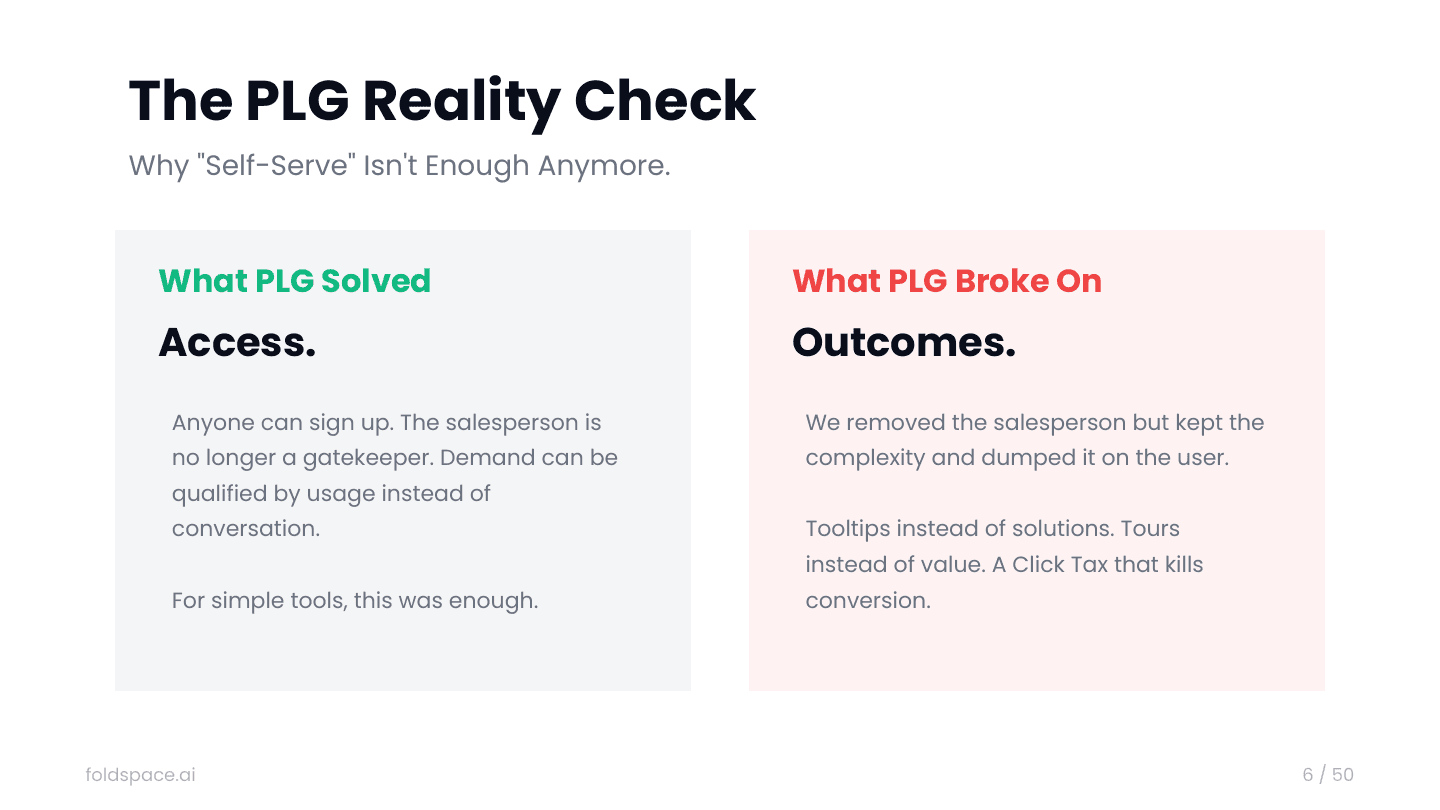
PLG solved access. Anyone can sign up. The salesperson is no longer the gatekeeper. Demand can be qualified by usage instead of by conversation. For simple tools, that was enough.
But PLG removed the salesperson and kept the complexity — and dumped it on the user. The result: tooltips instead of solutions, tours instead of value, and a Click Tax that quietly kills conversion in any product more sophisticated than a notepad.
The numbers are brutal once you go look:
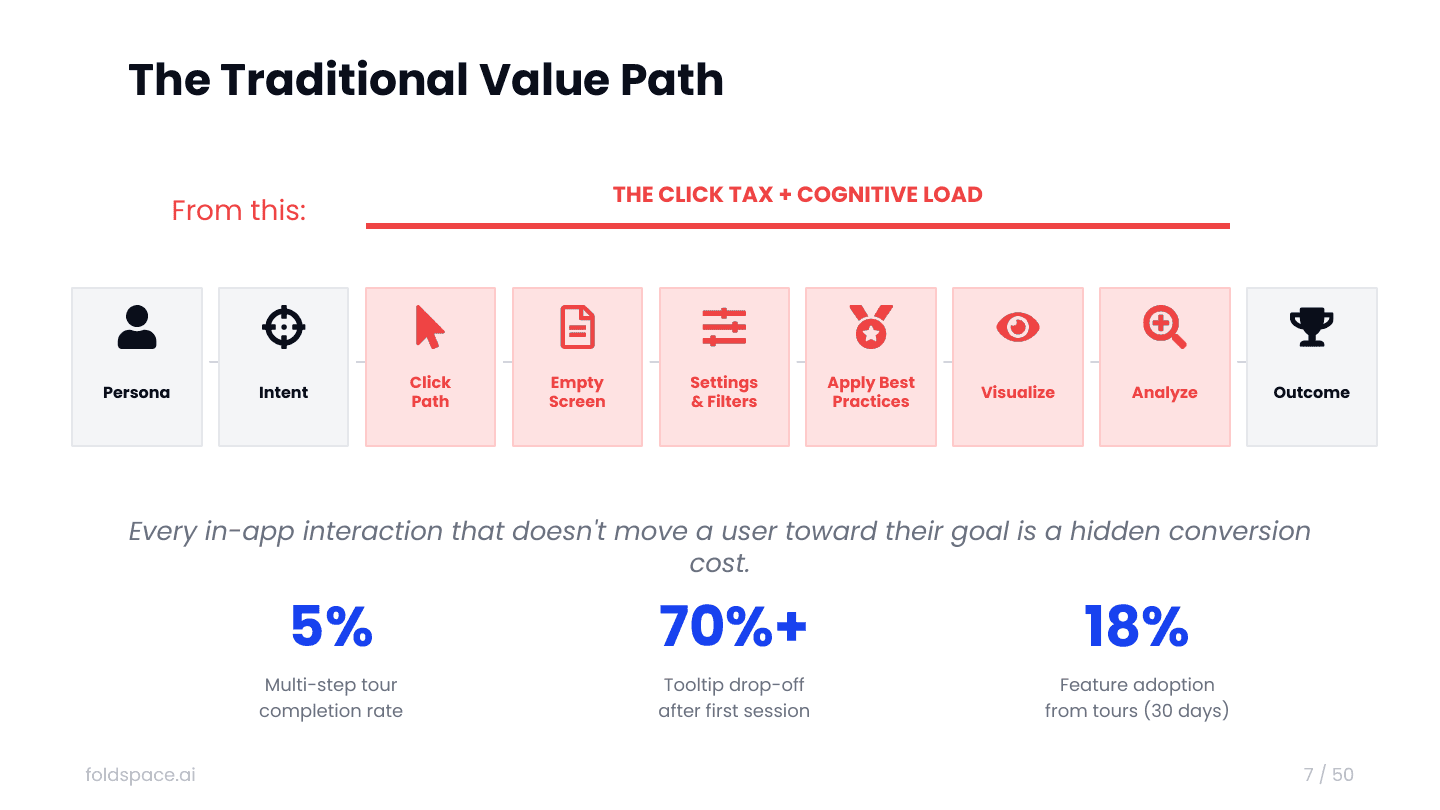
- 5% complete a multi-step product tour.
- 70%+ drop off tooltips after the first session.
- 18% is the 30-day feature adoption rate from tours.
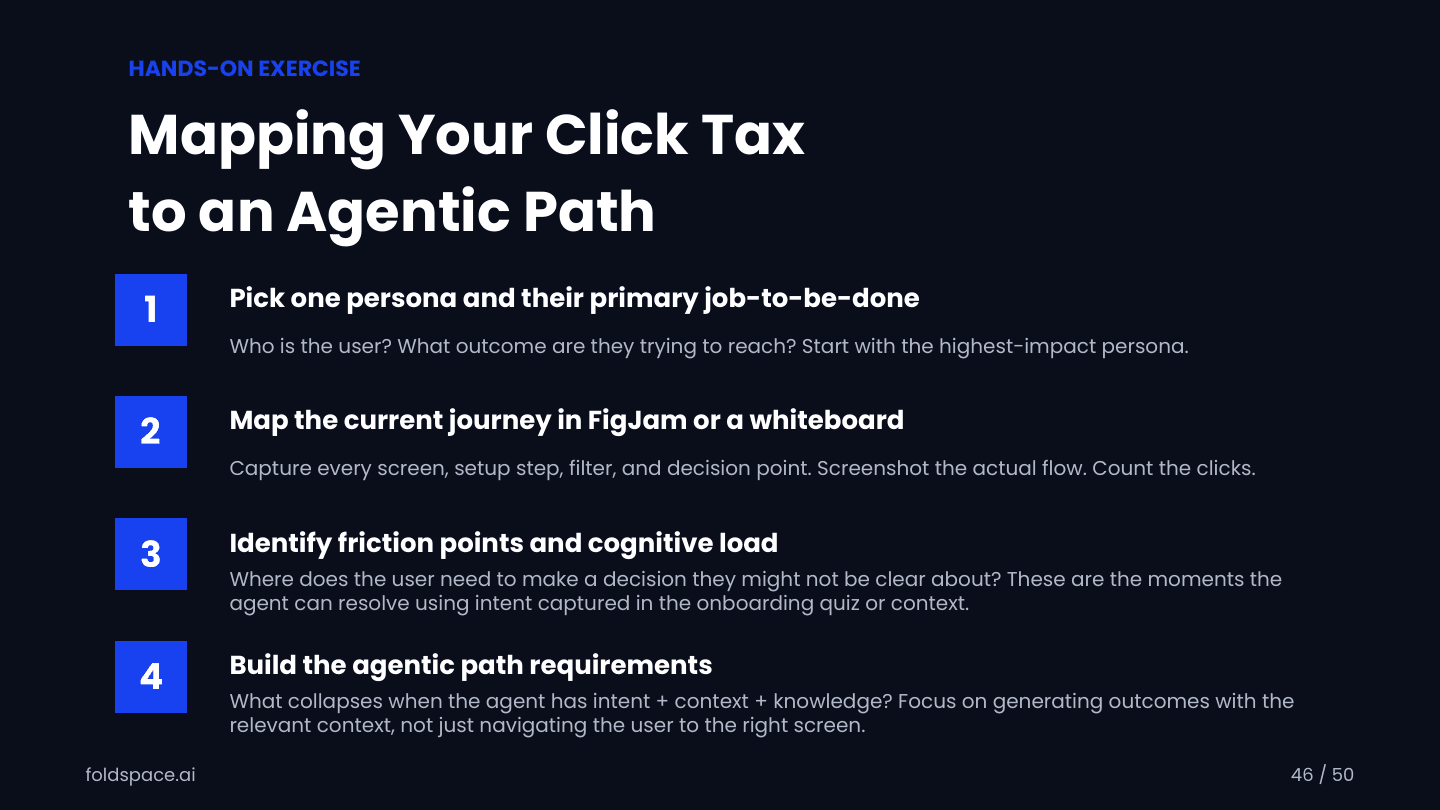
Every in-app interaction that doesn't move a user toward their goal is a hidden conversion cost. The user journey looks like this: Persona → Intent → Click → Empty screen → Settings → Apply best practices → Visualize → Analyze → Outcome. Nine steps to get value. Most users never make it.
The shift: from clicking to prompting
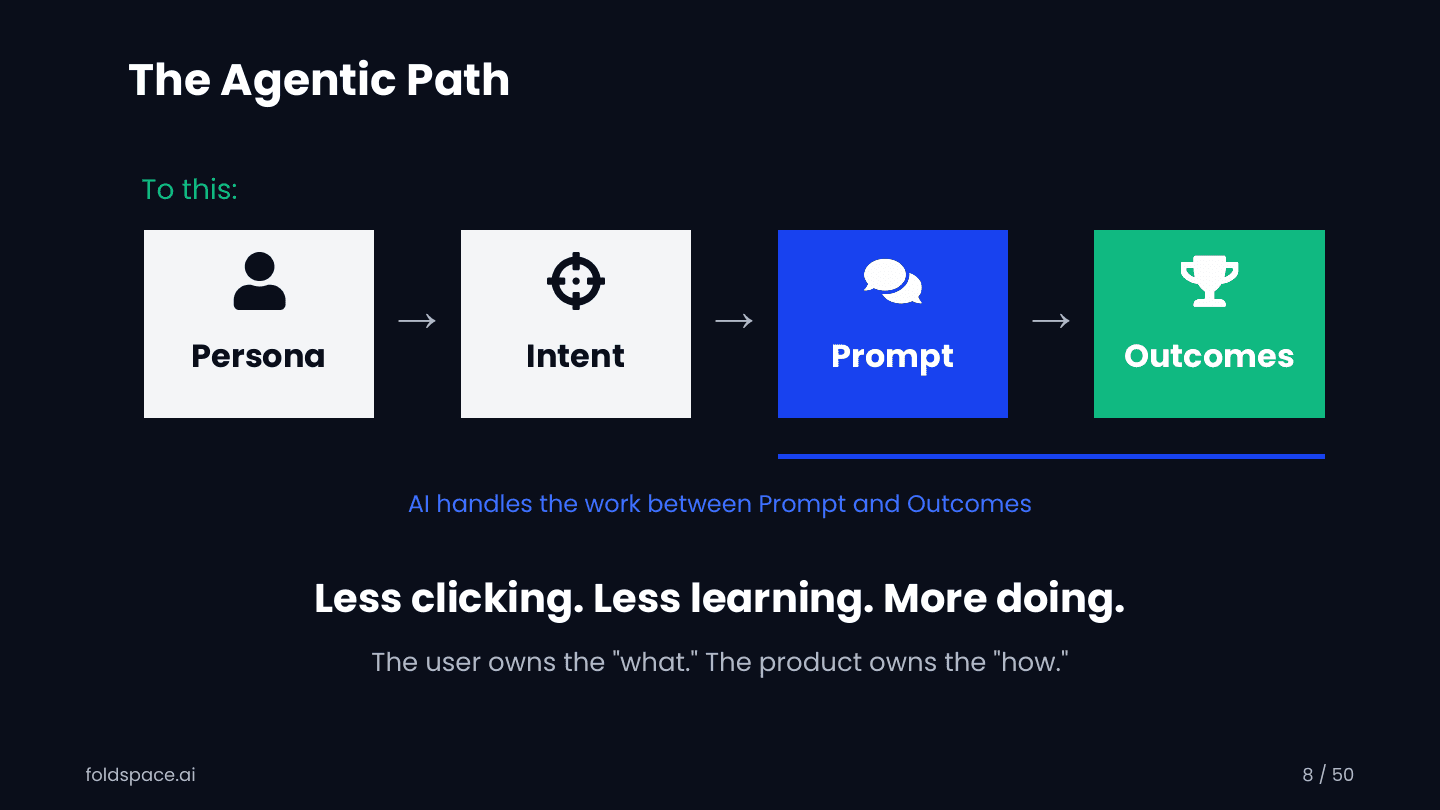
The agentic path collapses that journey. Persona → Intent → Prompt → Outcomes. Four steps. The AI handles everything between the prompt and the outcome — the settings, the filters, the configuration, the empty-screen problem, the best-practice decisions. The user owns the what. The product owns the how.
This is what we mean when we say AI-First Growth:
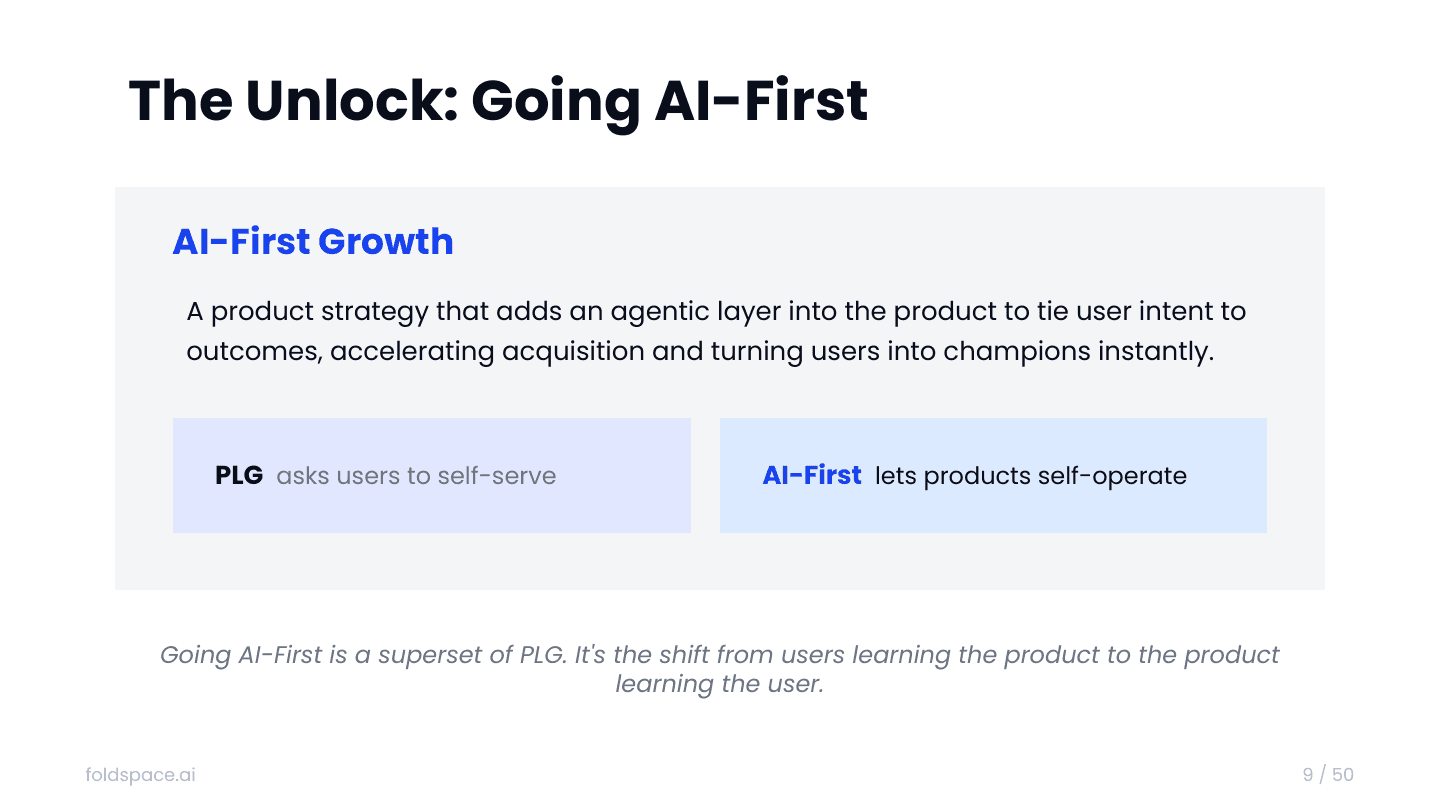
AI-First Growth is a product strategy that adds an agentic layer into the product to tie user intent to outcomes, accelerating acquisition and turning users into champions instantly.
AI-First is a superset of PLG, not a replacement. It preserves the self-serve motion and adds the agentic execution that finally makes complex software actually self-serve.
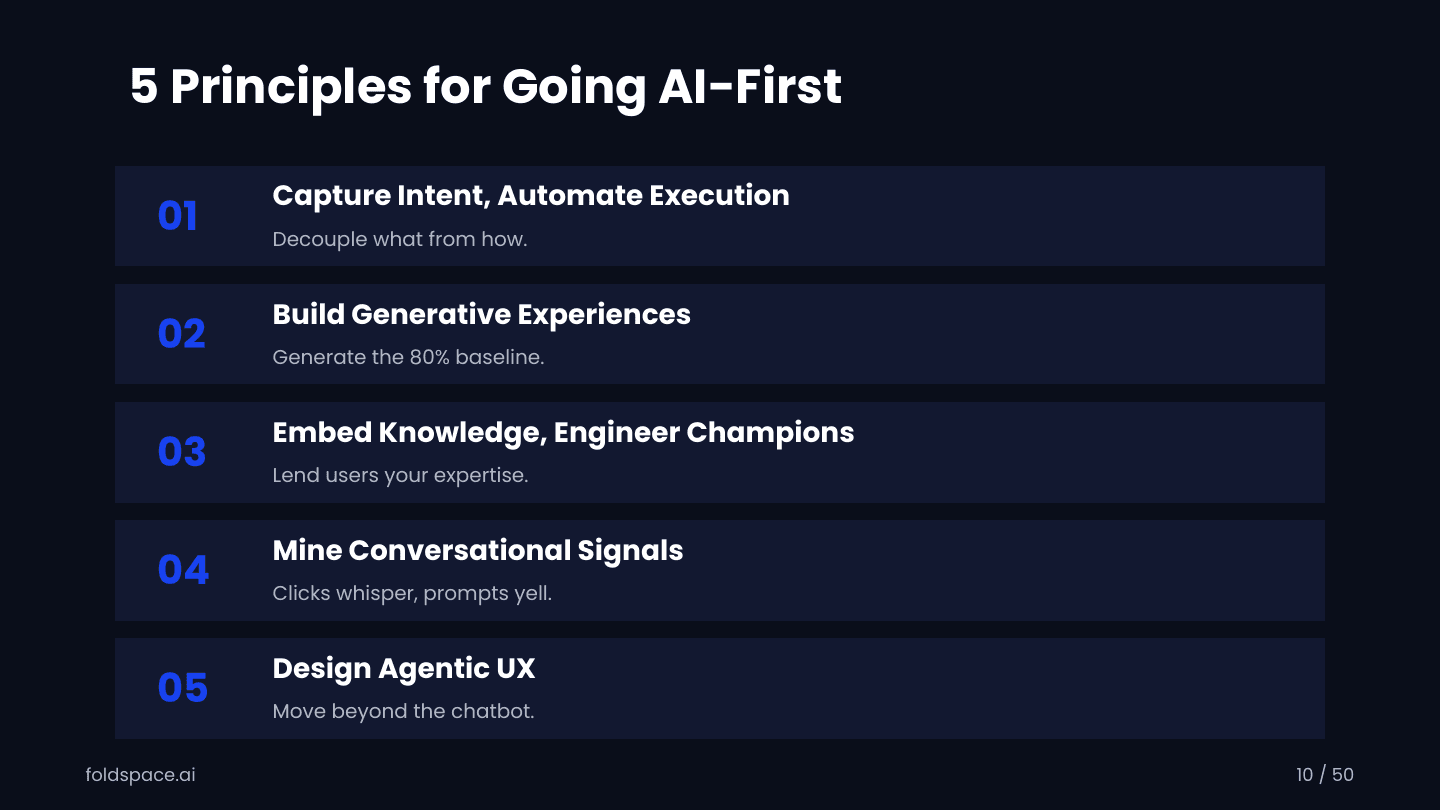
The five principles
Principle 1 — Capture Intent, Automate Execution
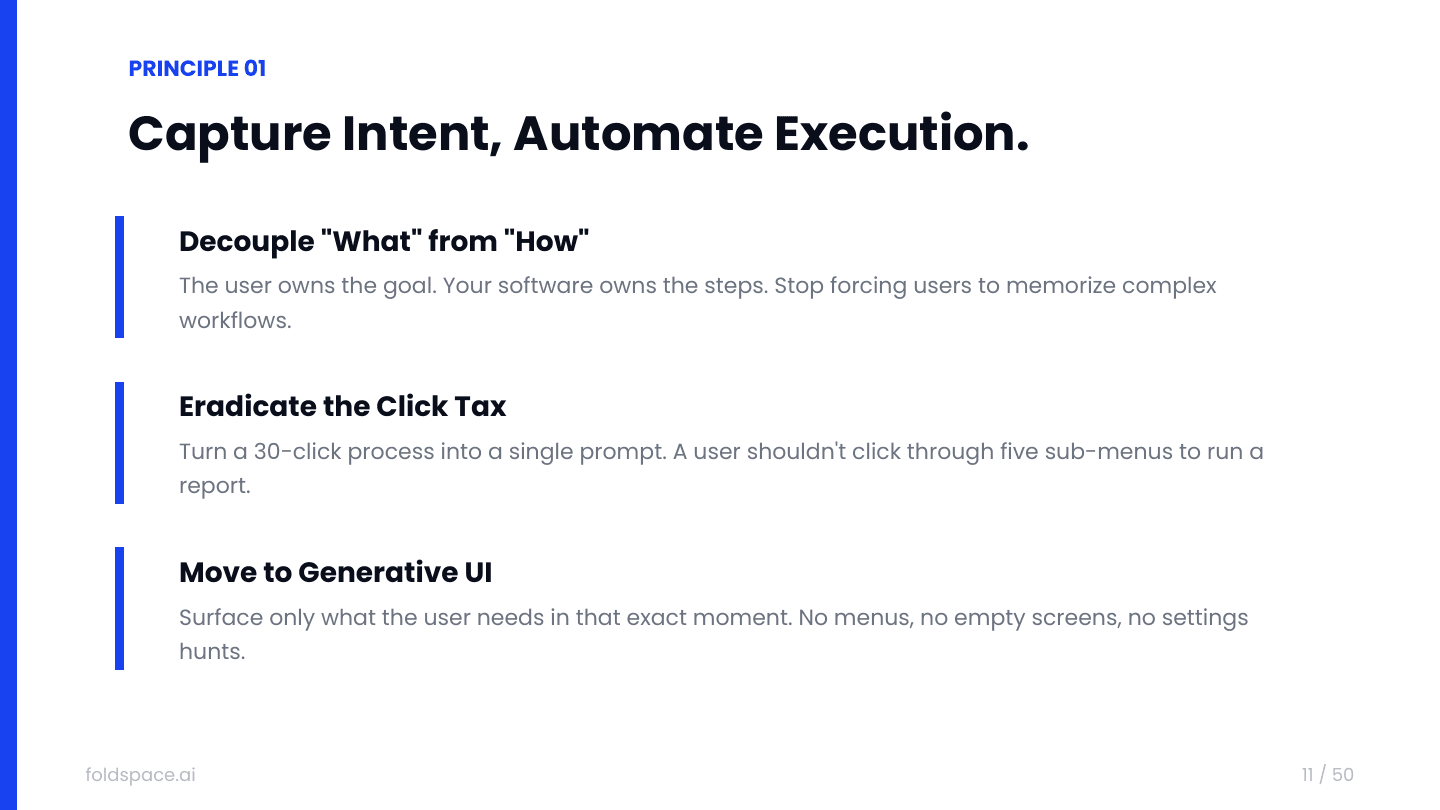
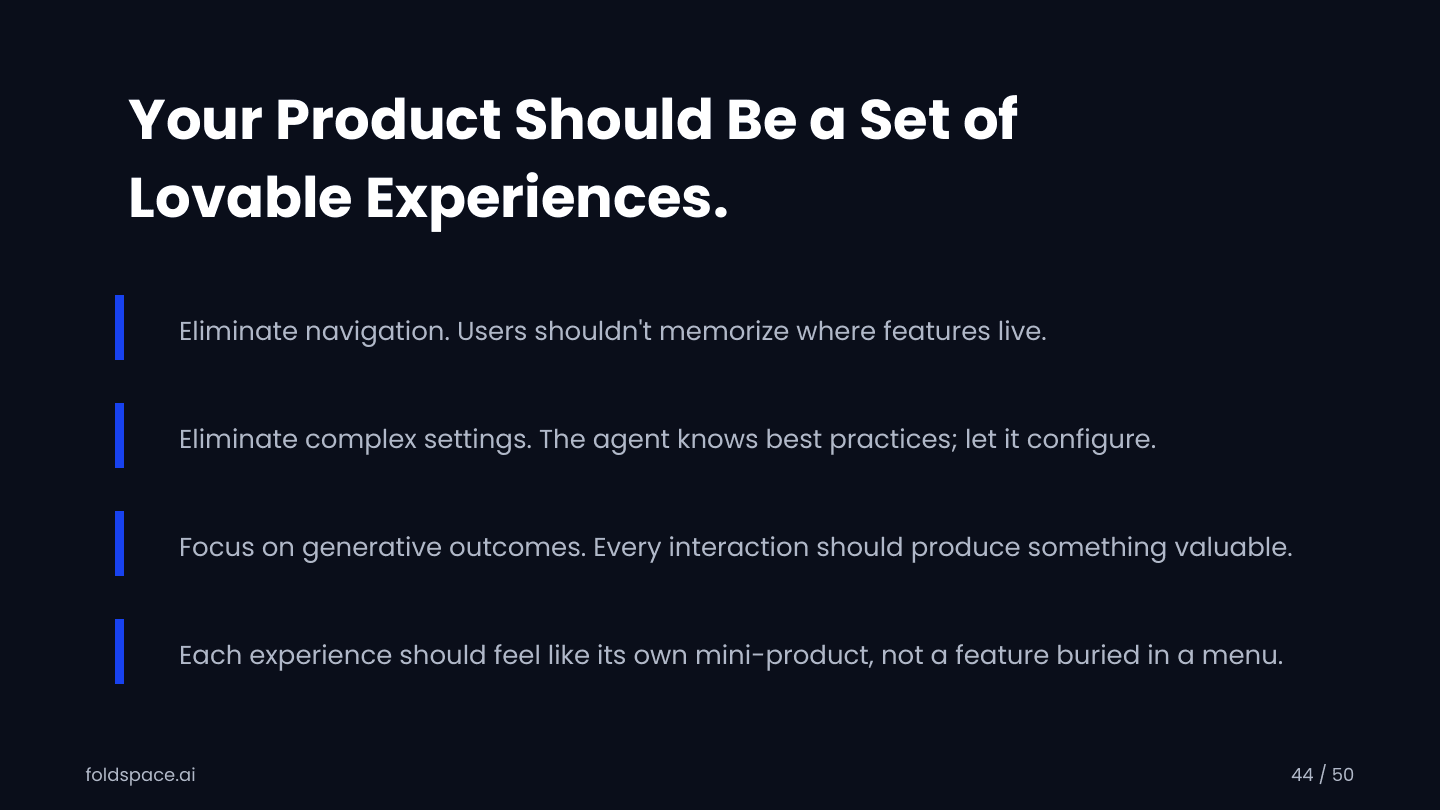
Decouple what from how. The user owns the goal. Your software owns the steps. Stop forcing users to memorize complex workflows.
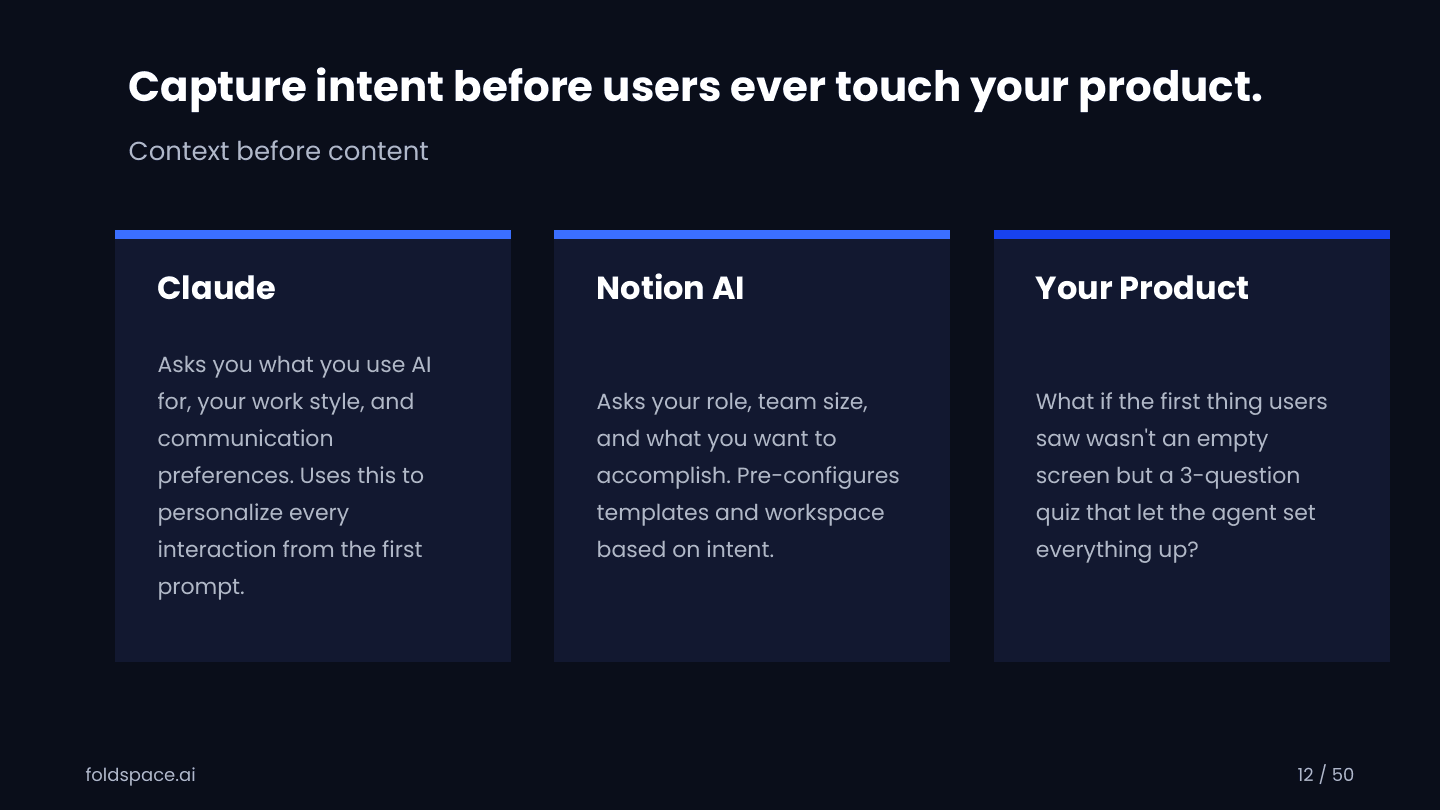
But here's the part most teams miss: intent capture starts before the user ever touches your product. The onboarding quiz is no longer a form-fill exercise. It's the moment your agent gets the context it needs to operate on the user's behalf for every interaction after.
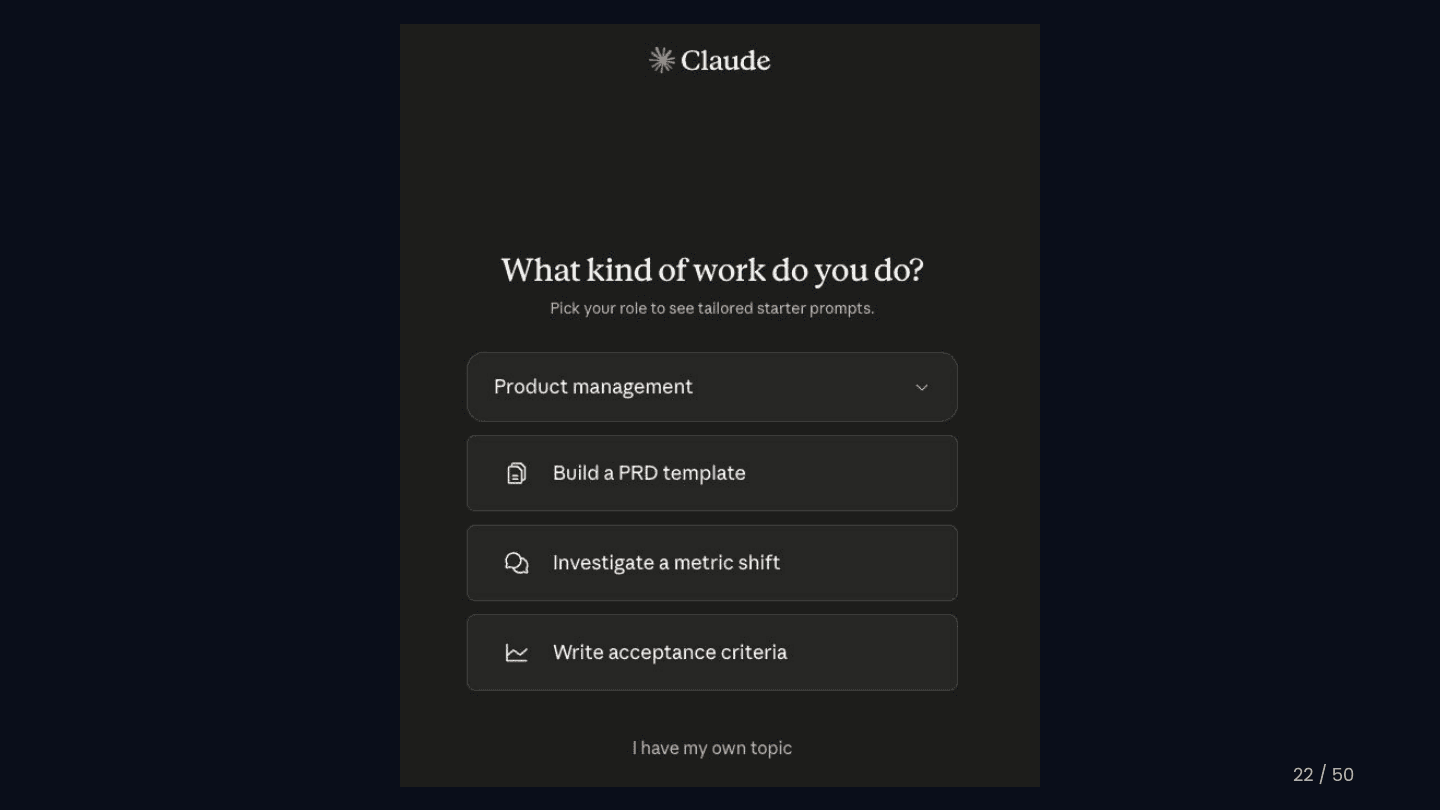
Look at how the AI-Native products do this — Claude asks what you use AI for and your work style; Notion AI asks your role, team size, and what you want to accomplish. What if the first thing users saw wasn't an empty screen, but a 3-question quiz that let the agent set everything up? The pattern is simple: context before content.
Principle 2 — Build Generative Experiences
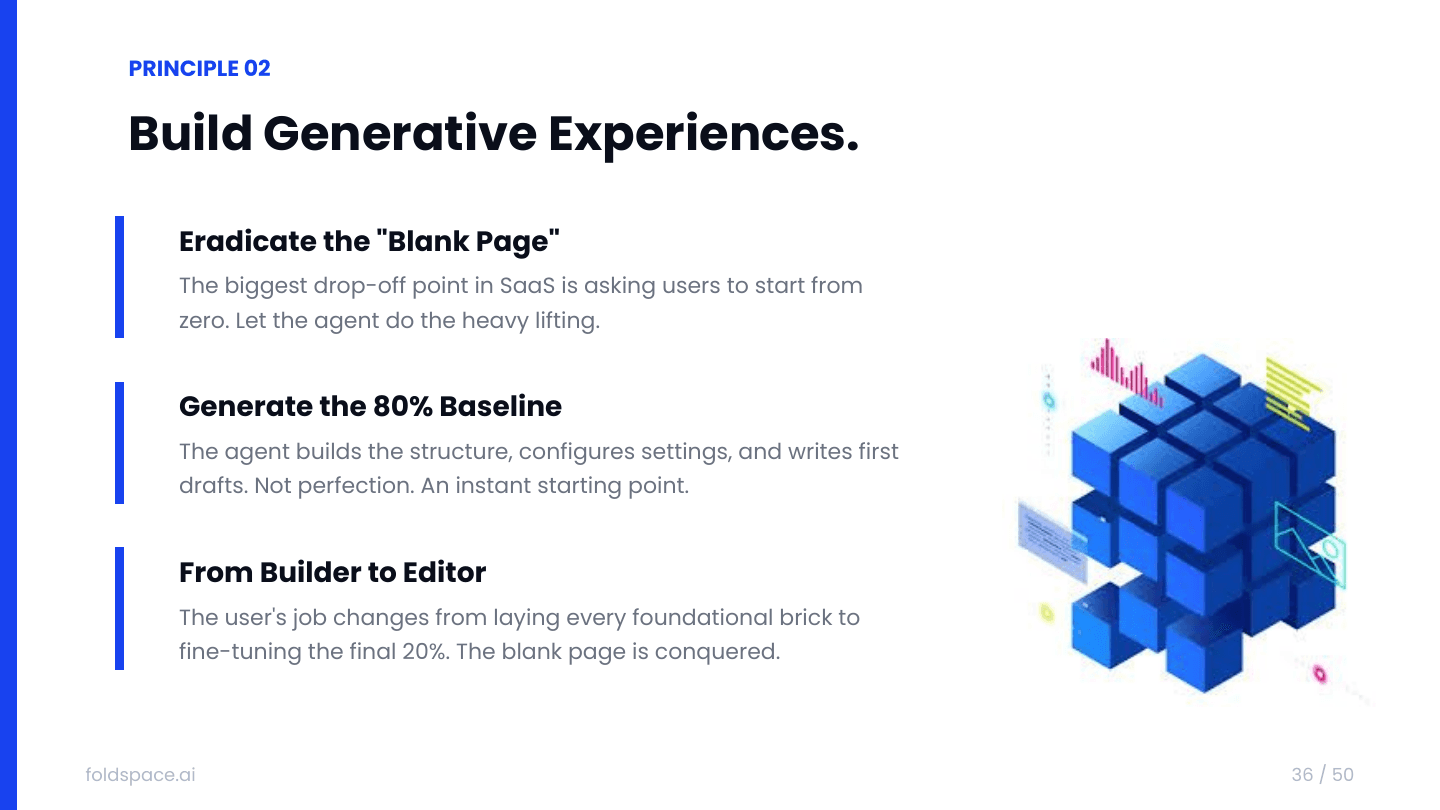
Generate the 80% baseline. The biggest drop-off point in SaaS is asking users to start from zero. The blank page is where activation goes to die. The agent should do the heavy lifting — build the structure, configure the settings, write the first draft. Not perfection. An instant starting point.
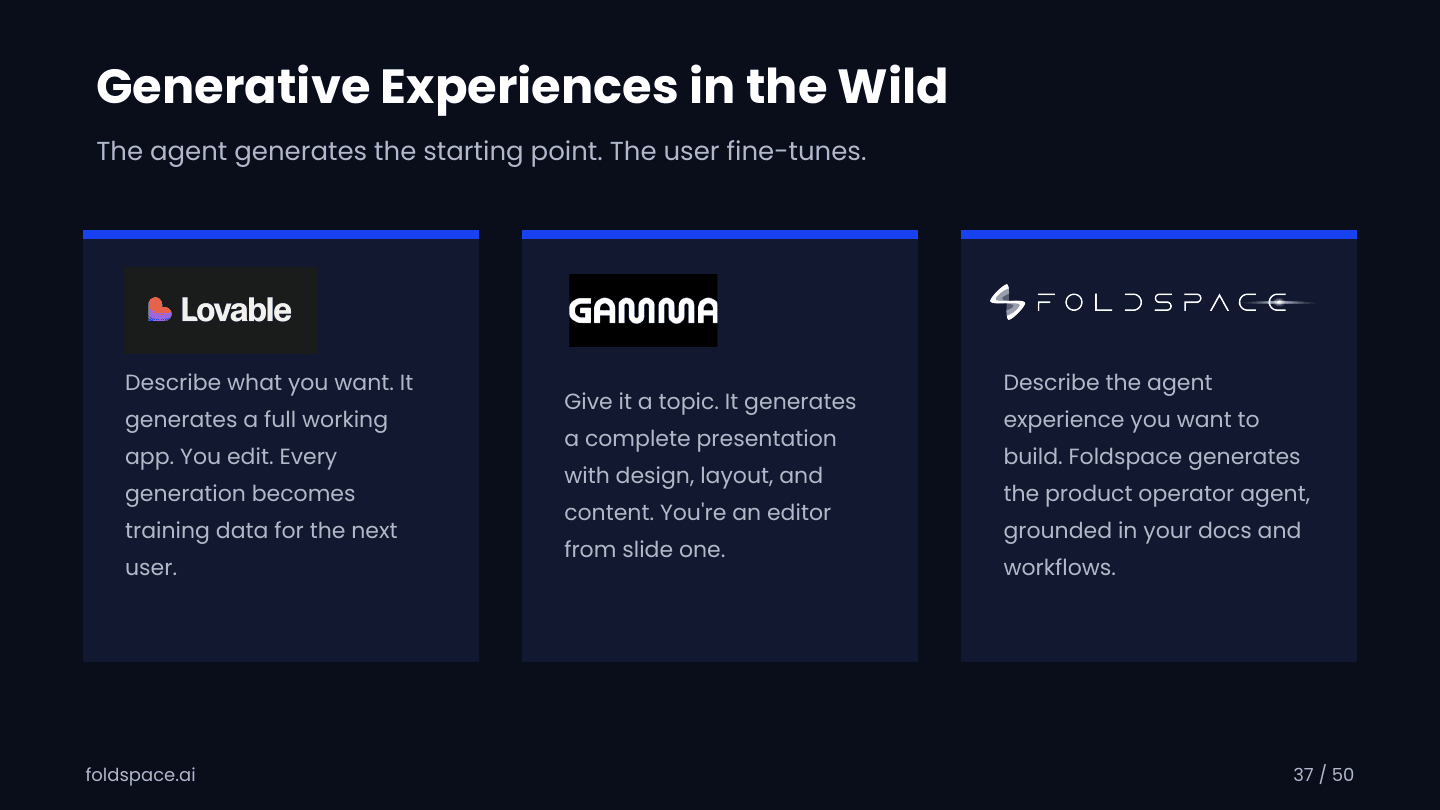
This is what changes the user's job: from laying every foundational brick to fine-tuning the final 20%. From builder to editor. You see this in the products users love most — Lovable generates a working app from a description; Gamma generates a full presentation from a topic. The question to ask of your own product: what can a user generate here? If the answer is nothing, that's your biggest opportunity.
Principle 3 — Embed Knowledge, Engineer Champions
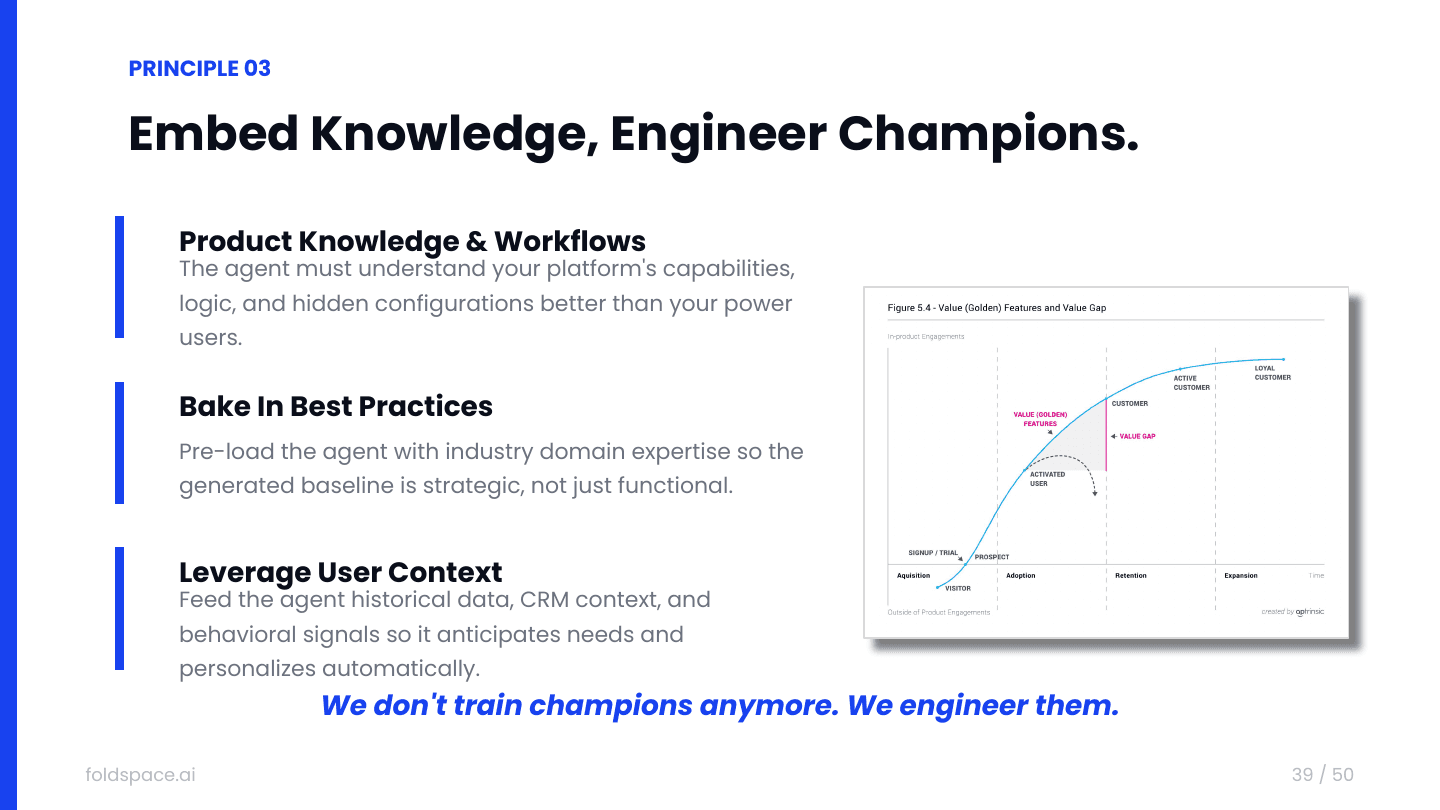
We don't train champions anymore. We engineer them. The agent must understand your platform's capabilities, logic, and hidden configurations better than your power users do. Pre-load it with domain expertise so the generated baseline is strategic, not just functional.
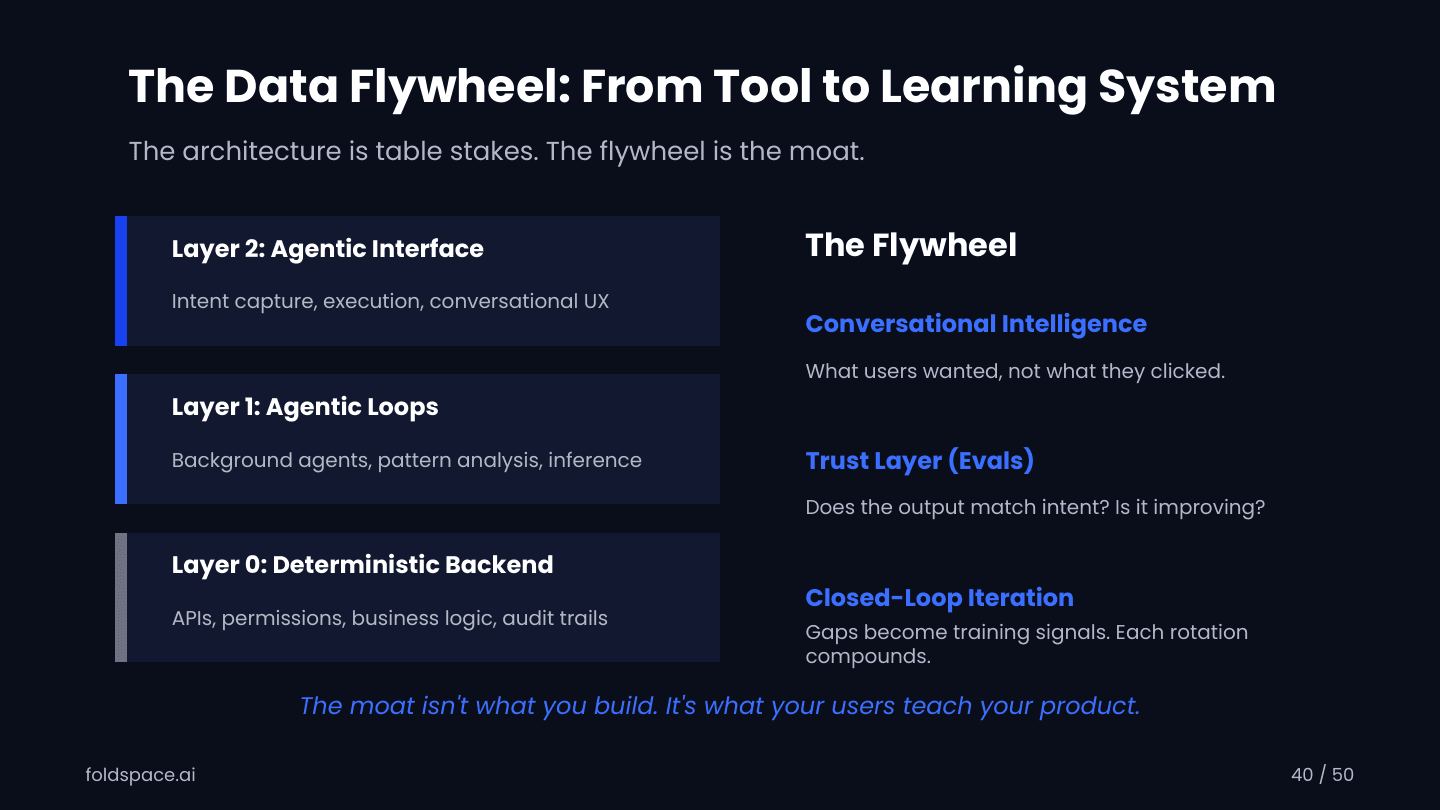
Three layers, one flywheel:
- Layer 0 — Deterministic Backend. Your APIs, permissions, business logic, audit trails. Becomes more important in an AI-Native world.
- Layer 1 — Agentic Loops. Background agents, pattern analysis, inference. This is where your IP lives.
- Layer 2 — Agentic Interface. Intent capture, execution, conversational UX. Where intent becomes action.
The architecture is table stakes. The flywheel is the moat. The moat isn't what you build — it's what your users teach your product.
Principle 4 — Mine Conversational Signals
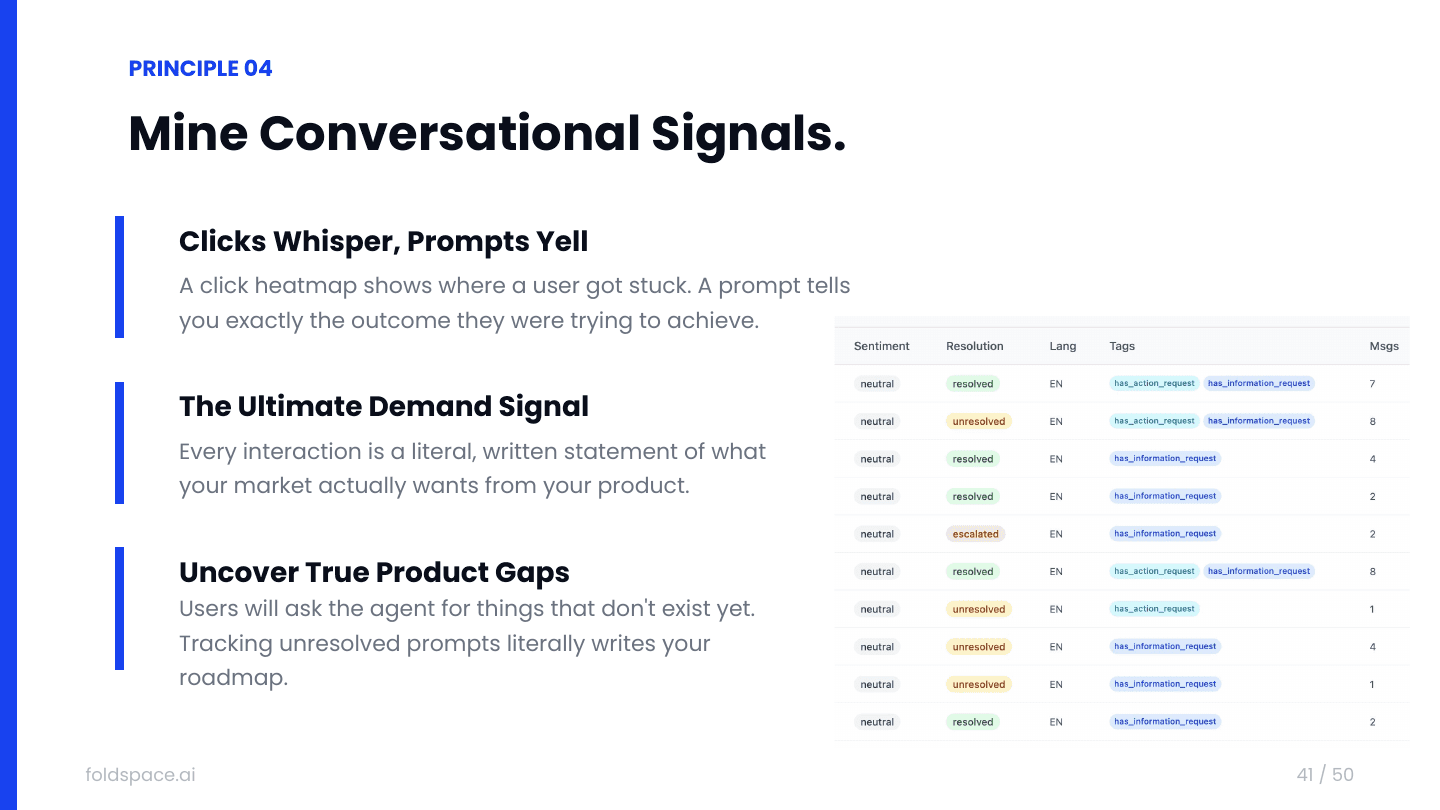
Clicks whisper. Prompts yell. A click heatmap shows where a user got stuck. A prompt tells you exactly the outcome they were trying to achieve. Every interaction with the agent is a literal, written statement of what your market actually wants.
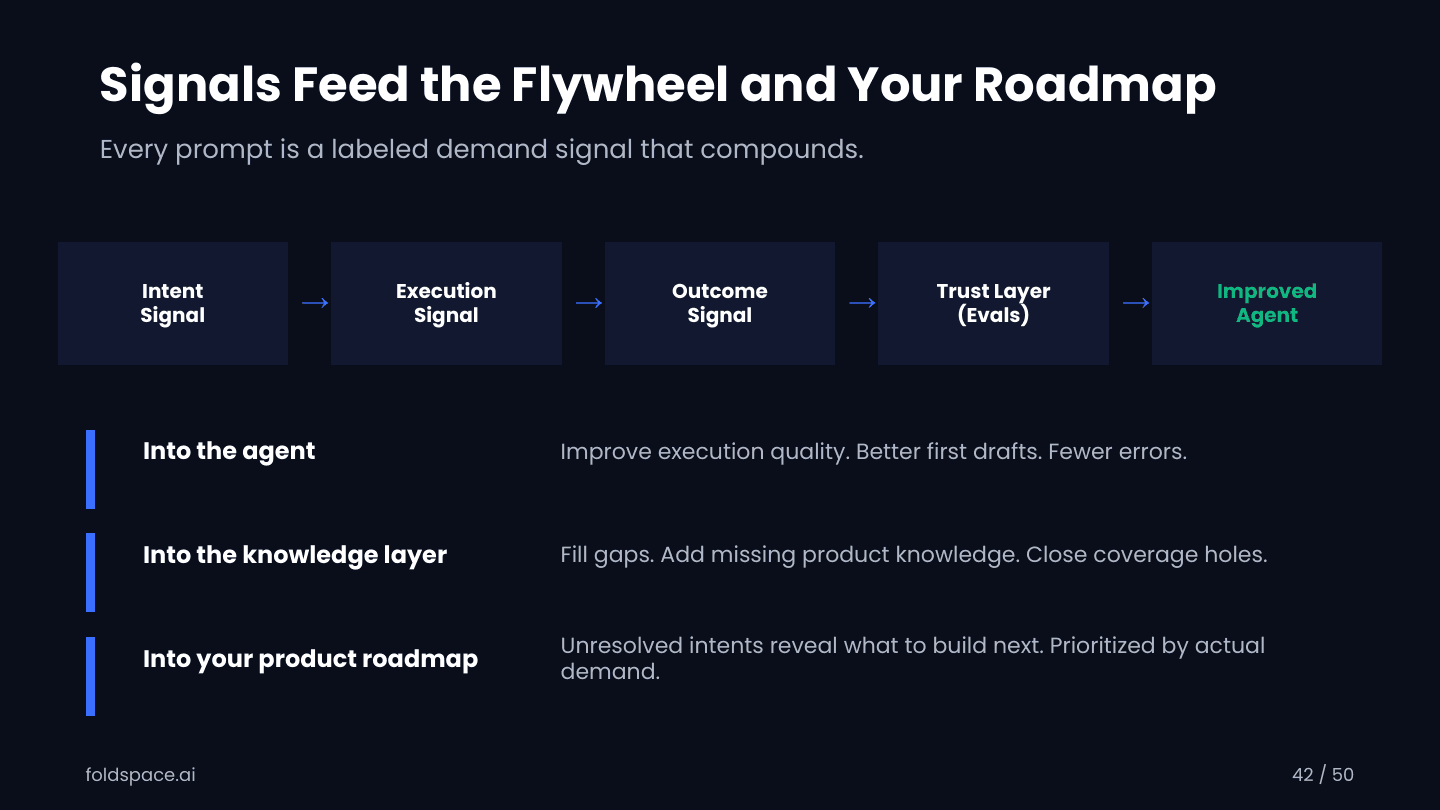
Tracking unresolved prompts literally writes your roadmap. Every prompt becomes a labeled demand signal that feeds three layers: into the agent (better execution), into the knowledge layer (fill gaps), and into your product roadmap (what to build next, prioritized by actual demand).
Principle 5 — Design Agentic UX
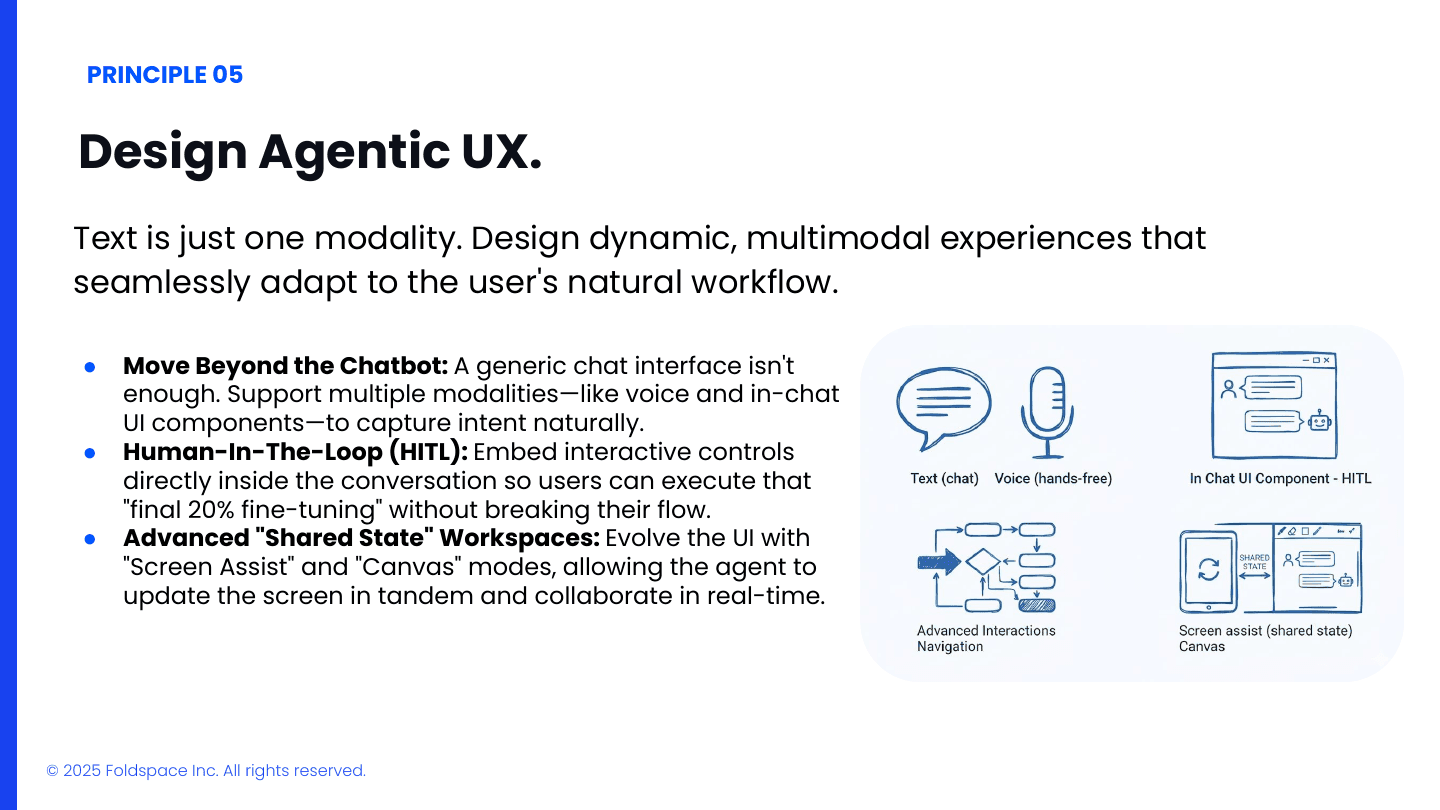
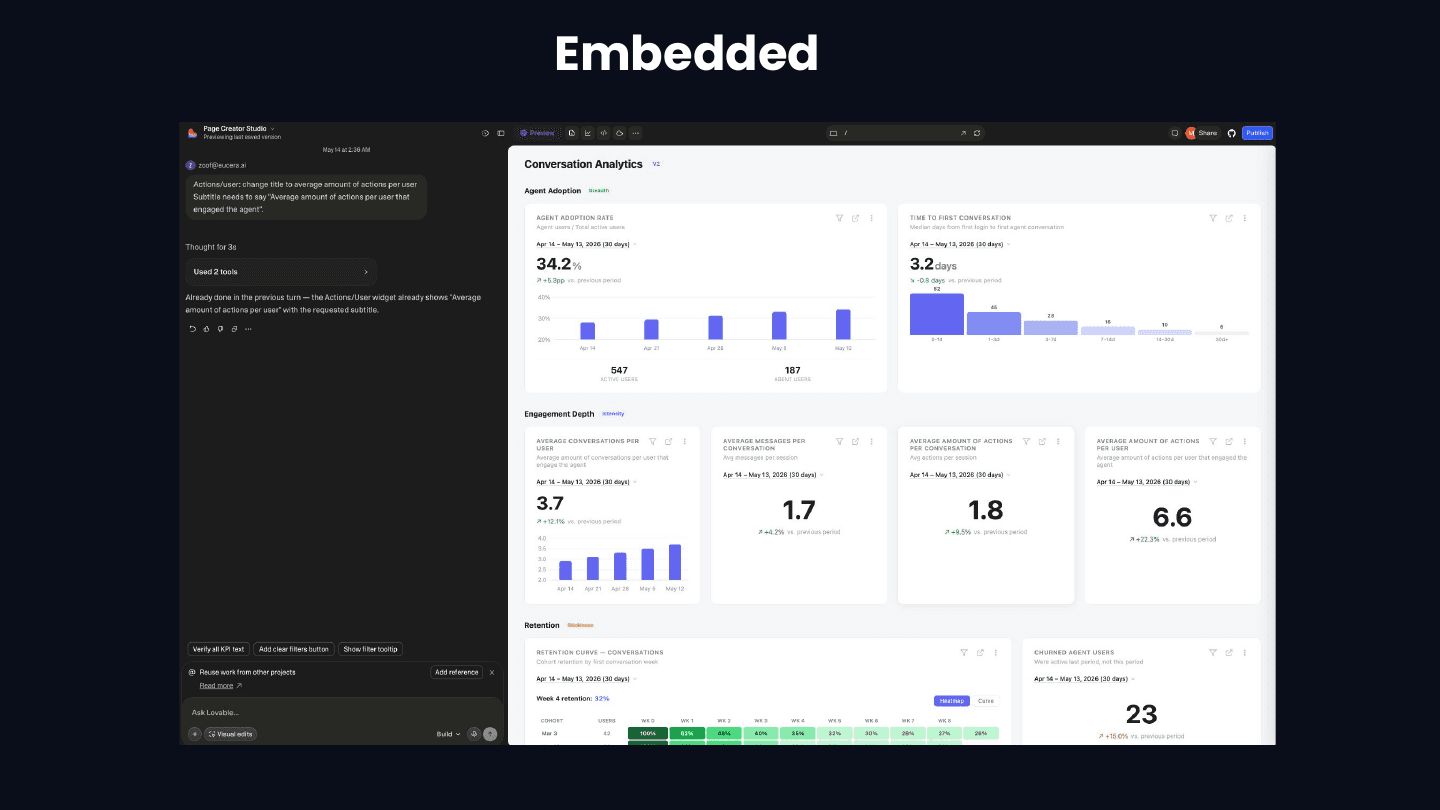
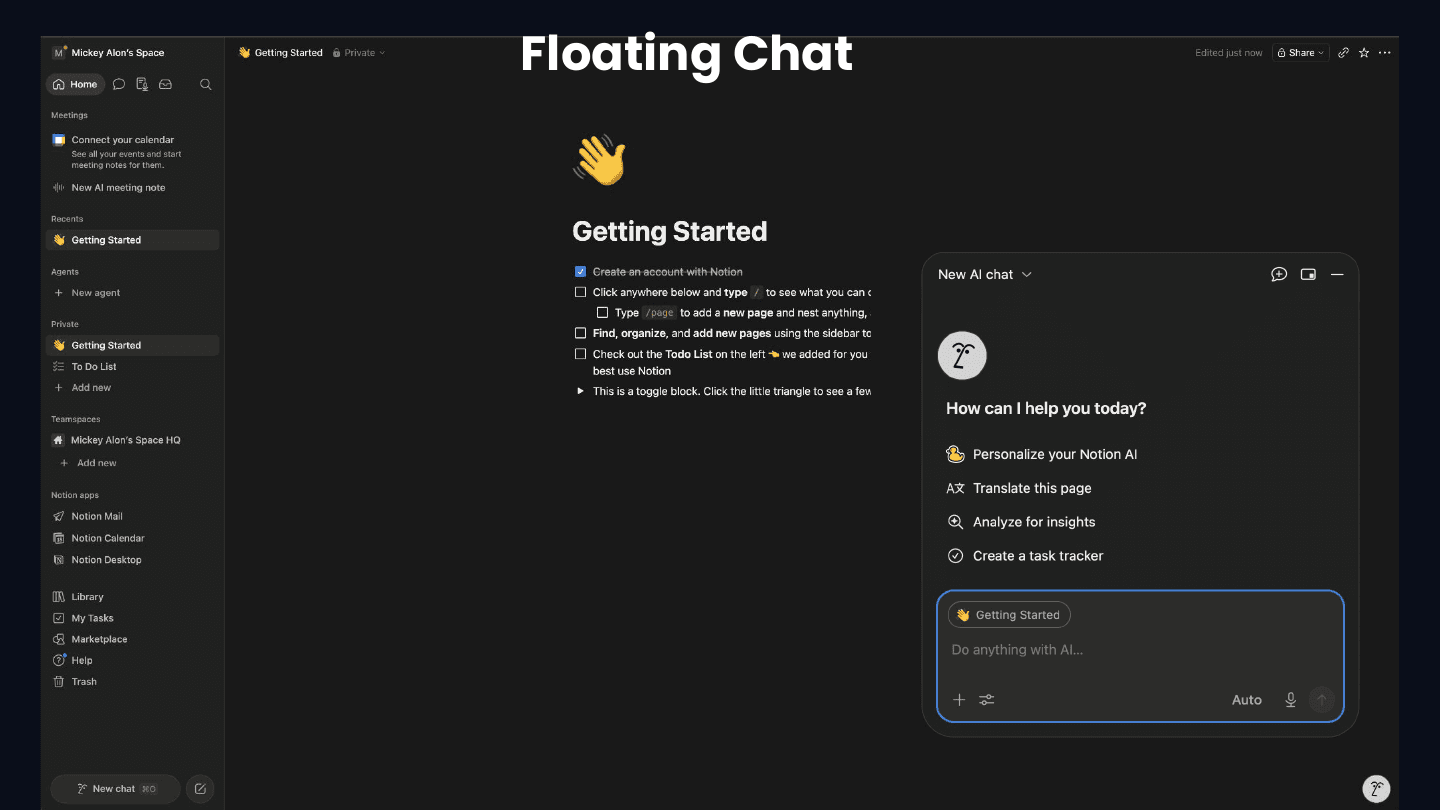
Move beyond the chatbot. Text is just one modality. Real agentic UX is dynamic and multimodal — voice, in-chat UI components, and shared-state workspaces where the agent and the user collaborate on the same surface in real time.
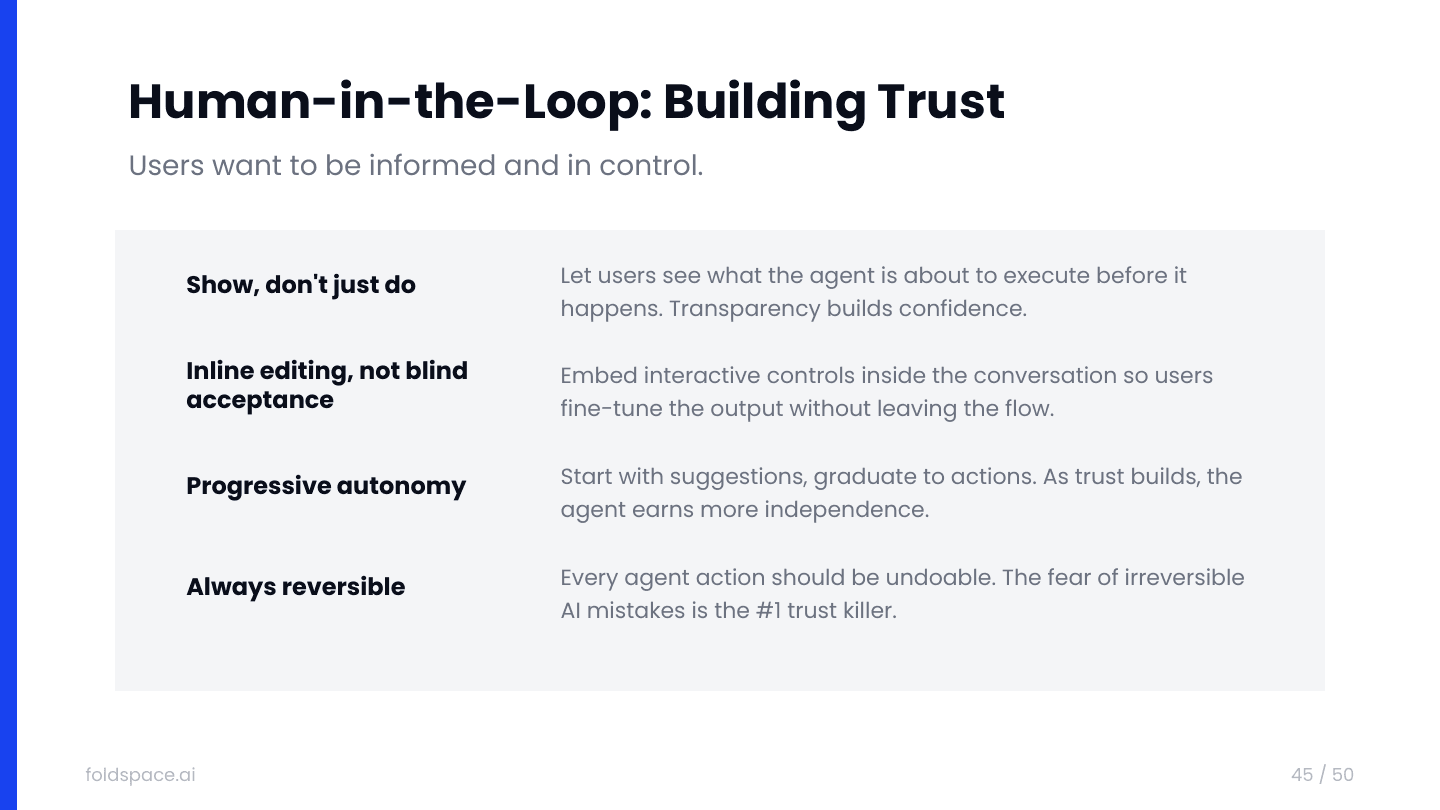
And because users are handing real work to an agent, trust is non-negotiable:
- Show, don't just do. Let users see what the agent is about to execute before it happens.
- Inline editing, not blind acceptance. Embed interactive controls inside the conversation.
- Progressive autonomy. Start with suggestions, graduate to actions.
- Always reversible. Every agent action should be undoable. The fear of irreversible AI mistakes is the #1 trust killer.
Sequence the roadmap
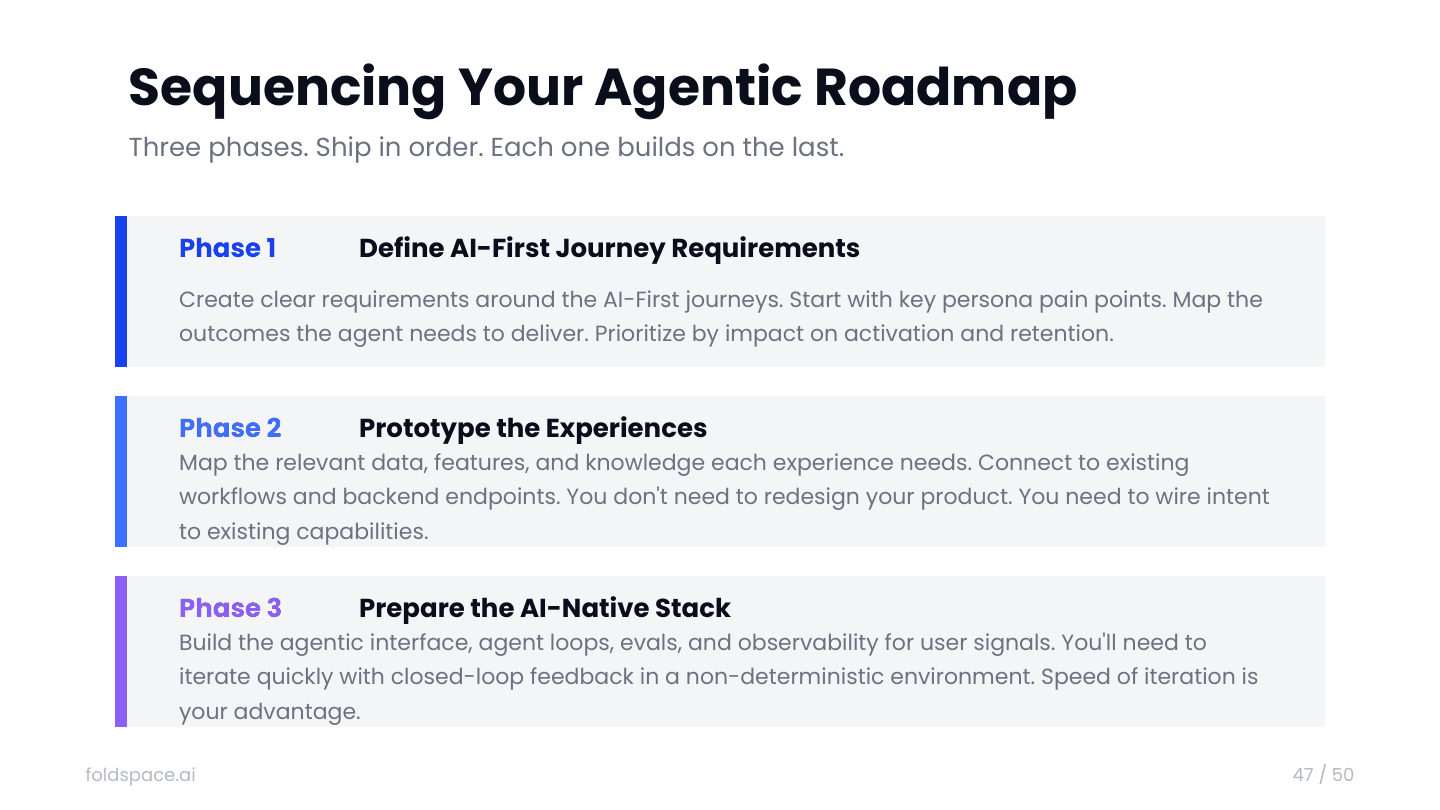
Three phases. Ship in order. Each one builds on the last.
- Phase 1 — Define AI-First journey requirements. Start with key persona pain points. Map the outcomes the agent needs to deliver. Prioritize by impact on activation and retention.
- Phase 2 — Prototype the experiences. Map the data, features, and knowledge each experience needs. You don't need to redesign your product. You need to wire intent to existing capabilities.
- Phase 3 — Prepare the AI-Native stack. Build the agentic interface, agent loops, evals, and observability for user signals. Iterate quickly with closed-loop feedback.
What good looks like
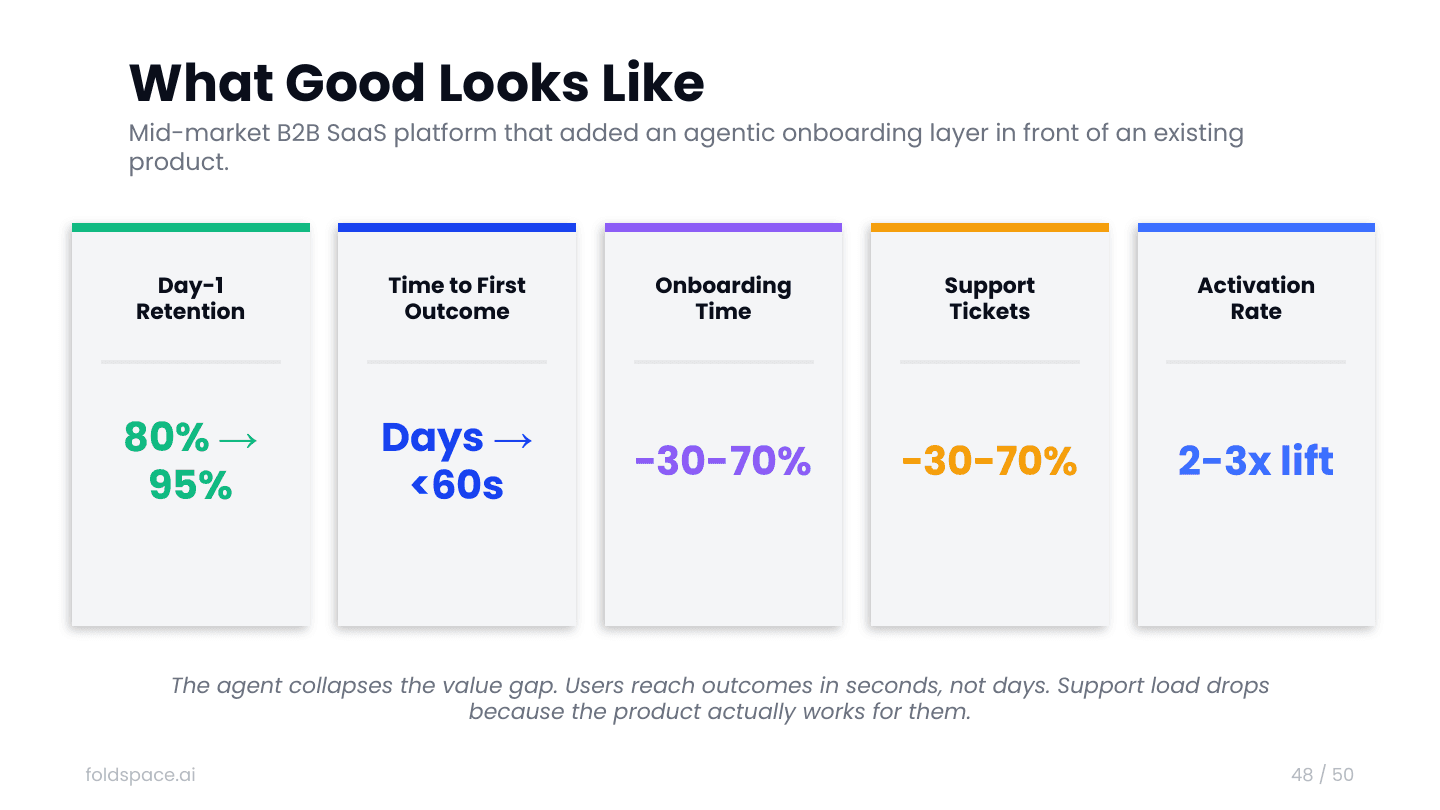
A mid-market B2B SaaS that added an agentic onboarding layer in front of an existing product:
- Day-1 retention: 80% → 95%
- Time to first outcome: days → under 60 seconds
- Onboarding time: -30 to -70%
- Support tickets: -30 to -70%
- Activation rate: 2–3× lift
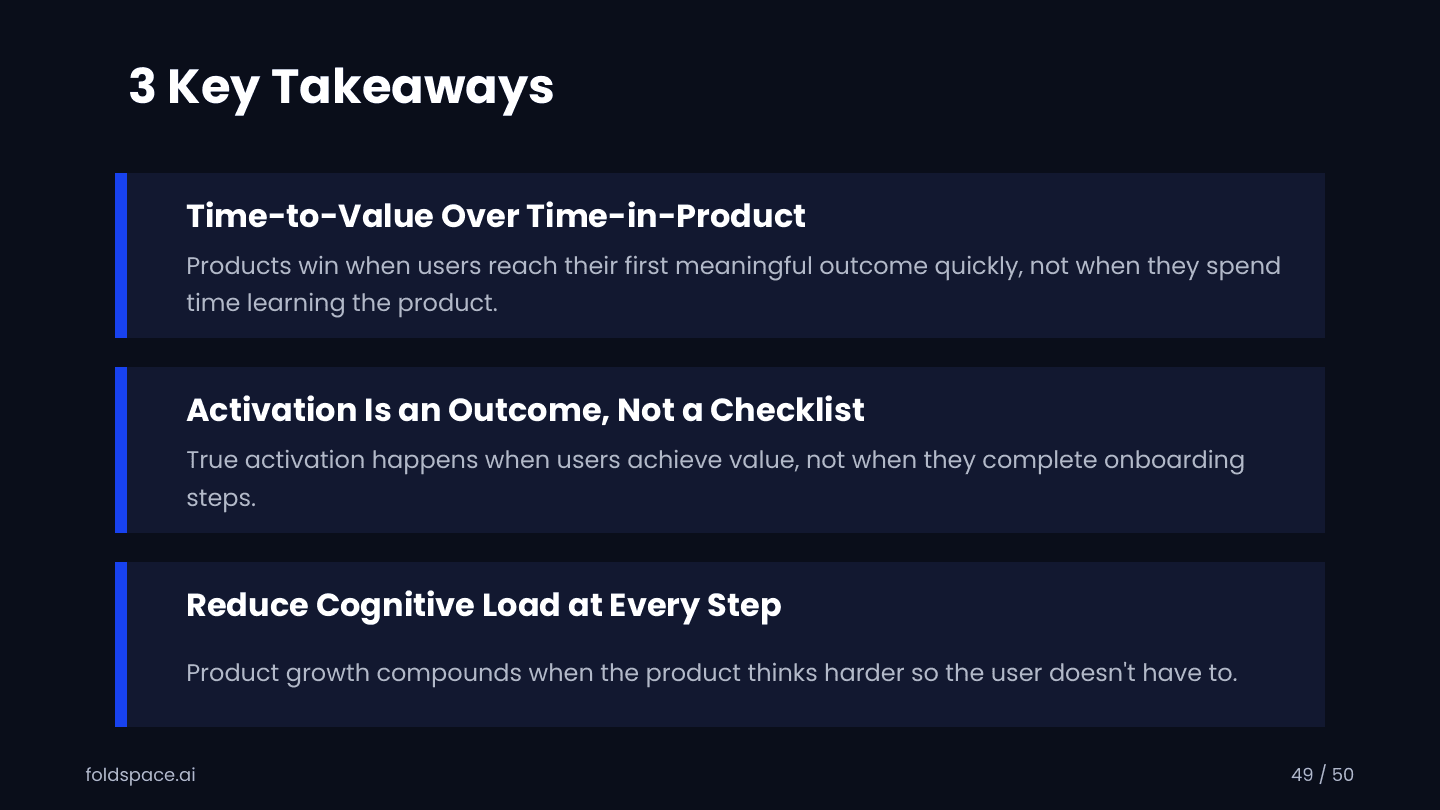
Three takeaways
- Time-to-Value over Time-in-Product. Products win when users reach their first meaningful outcome quickly.
- Activation is an outcome, not a checklist. True activation happens when users achieve value.
- Reduce cognitive load at every step. Growth compounds when the product thinks harder so the user doesn't have to.
Mickey Alon — Co-Founder & CEO, Foldspace AI Ramli John — Founder, Delight Path