Skip to content
vs.

Guidance teaches the software. Foldspace does the work.

Whatfix guides people through software and trains them on it.Foldspace does the task, so there is less to learn.

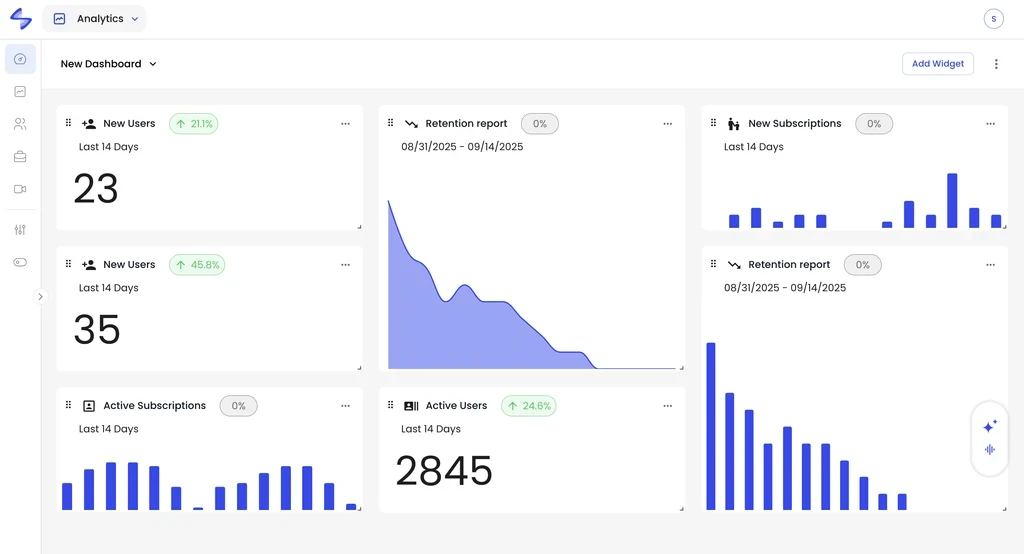
Foldspace includes product analytics Users, subscriptions and retention in the same place as intent.

  • Action
  • Navigation
  • Chat & Voice
  • Tandem
  • Generative UI
  • Kemtai
  • Vidmob
  • Metadata.io
  • RoofSnap
  • Optibus
  • AskCody
  • Base
  • Evercommerce
  • Mixmax
  • Togal.AI
  • Sustainable Minds

Users want it done, not explained.

81.5% of user requests ask agents to act, not to answer a question.
Here is what that does for the business.

4.4x
Conversion liftUsers of the agent · Mixmax
−48%
Time to paid5 days to 2.6 · Mixmax
30%
Faster onboardingFirst month on Foldspace · Base AI
+72%
Week-one engagement46% to 79% · Mixmax

Why companies choose Foldspace

01 Onboarding Agents that do the work

Where Whatfix falls short

Whatfix is a digital adoption platform built mainly around step-by-step in-app guidance, with practice simulations for training. New users still need to do the work, and guidance tied to your screens needs updating whenever the UI changes.

Why Foldspace does it better

From the first session, users say what they want and Foldspace does it with the features you shipped: the setup, the configuration, the first real task. No one has to learn every screen first. The agent runs the workflows your team builds and approves, with each user's own permissions.

Business impact with Foldspace

Foldspace shortens onboarding: new users reach value in their first session instead of getting stuck in a setup guide, which accelerates time to value and brings more free-to-paid conversions and stronger retention.

02 A Product Agent to increase adoption

Where Whatfix falls short

Whatfix's AI helps your team build guidance, and it answers users from your documentation. Getting users to adopt what you shipped still runs through guides.

Why Foldspace does it better

Foldspace is the Product Agent. Users type or speak what they want, and it knows your product and puts its features to work. The Agent Builder builds it on your product without changing your code.

Business impact with Foldspace

Foldspace grows adoption of everything you already built, without another UI redesign. Users get more value out of the product, quicker, which grows revenue and lowers churn.

03 Feed your roadmap
with real user conversations,
not just clicks

Where Whatfix falls short

Whatfix shows what users did and what they searched for in its in-app help. Feedback comes in through surveys, so closing a gap means new guidance, new training or a roadmap item.

Why Foldspace does it better

Foldspace covers both: classic usage and retention, plus the intent behind every request in the user's own words, whether it got done, and the product gaps users run into, ranked for your roadmap. Intent feeds your roadmap, for your team to decide. Some gaps you can close the same week with a new agentic experience, without waiting for a release.

Business impact with Foldspace

Foldspace gives you the evidence for roadmap calls you can defend: what your customers are asking for, in their own words, and how often. You ship what users already want, so each release gets adopted and fewer customers leave over a missing feature.

Foldspace vs. Whatfix
Key Capabilities Compared

What your business needs
Getting users to the outcome An agent that does the task for the user, fills in forms and shows cards and pickers in the conversation, so they get the outcome in one request In-app guidance that walks users through the steps, with some steps automated, plus AI that answers from your documentation
Guiding users through the product The agent navigates, acts in your web app, and can be triggered from your own buttons and backend Walkthroughs, tips, beacons, launchers, pop-ups, task lists and an in-app help center
Understanding user behavior Product analytics with funnels, retention and session replay, captured automatically for users and the agent, with no manual event tagging Product analytics with auto tracking, cohorts, journeys and session replay
Understanding what users want Conversational Analytics shows what each user asked for in their own words, whether it got done, and how they felt about it Surveys with an AI summary of sentiment, plus what users search for in in-app help
Knowing what to build next User conversations show where users get stuck, in their own words, and feed your roadmap. Product gaps and knowledge gaps show what to build or document next Surveys and in-app search terms show where users get stuck, for your team to turn into new guidance or roadmap items
An agent built for your product Your own Product Agent, built on your product in minutes by the Agent Builder. It answers from your content and speaks your users’ language AI agents that help your team build guidance and analyze data, guide users with answers and steps, and run training roleplay
Working with your own agents Your agents plug in over A2A and MCP. The Product Agent hands work over and brings the result back to the user Guidance and analytics for how employees use AI tools. Its workflow agent, in beta, automates multi-step work across business apps
Setup and developer tools One snippet and your team’s approval to go live. The Product MCP generates action-handler code in Claude, Cursor and VS Code, and agent events can flow to Mixpanel, Amplitude and Segment A JavaScript embed, a browser extension, a mobile SDK, and support for desktop and Citrix apps
Security and data ISO 27001 certified, SOC 2 Type II and GDPR compliant. The agent acts within each user’s own permissions, masks personal data per agent, and keeps data in US or EU data centers SOC 2 Type II, ISO 27001, ISO 42001 and HIPAA, with data in the US or Europe


Companies add Foldspace to solve these problems

  • 80% of features in the average product are rarely or never used. Pendo Feature Adoption Report, 2019
  • 15% of product leaders say users are embracing their AI features. Pendo survey, 2024
  • 49% of product teams lack time for strategic planning, roadmap development or data analysis. Atlassian, State of Product 2026
  • 46% of product managers name resource limits as the top barrier to experimentation. CleverTap, Dec 2024
“Foldspace AI helps us accelerate the shift towards an agentic product experience. With their platform, we've been able to leapfrog to the future of SaaS UX.”
Allan Mørch, CEO, AskCody Allan MørchCEO, AskCody

Already building your own agent?

Your team's edge is your domain. Spend it there.

Build the brain, buy the operator.
Foldspace is the operator.

Already built your own chat UI?
Keep it and run Foldspace behind it.

Your users

The operator

Foldspace runs it

  • Chat and voice
  • Actions in your product
  • Agentic UI
  • Each user's permissions
  • Analytics on every request
The brain

Your domain expertise

  • Your agents
  • Your back-end workflows
  • Your data and logic
  • Your industry know-how

Book a demo

See Foldspace on your product.

  • No re-platform. The agent sits on your existing front end and back end.
  • One snippet. Going live is one snippet and your team's approval.
  • Nothing new to learn. Users ask, and the agent does the task.
  • Plugs into your analytics. Agent events can flow to Mixpanel or Amplitude.
Security

Enterprise grade compliance

ISO 27001 Information Security AICPA SOC 2 GDPR
Visit our Trust Center →

Frequently asked questions

Is Foldspace a Whatfix alternative?

For the product you ship to customers, it can be an alternative or an add-on, and the choice is yours. You can keep Whatfix and add Foldspace for the work users still do by hand. If guidance in your own product is the main thing you use Whatfix for, you can move that job to the agent when your contract comes up for renewal. Run both side by side first, then decide.

What is the difference between Foldspace and Whatfix?

Foldspace works for your users inside your product. Users say what they want, and it does it in the live product: it runs actions through your product's own APIs, navigates, answers from your product's knowledge and shows agentic UI in the conversation, within each user's own permissions. Whatfix is a digital adoption platform used widely for the software employees use at work, with guidance, in-app help, analytics and training simulations, plus AI agents that help your team build guidance and analyze data, answer and guide users, and run training roleplay.

Is Foldspace a digital adoption platform?

Foldspace has the same goal as a digital adoption platform: getting users to the outcomes your product was built for. The approach is different. Whatfix guides users through the interface with in-app guidance, and can automate some steps. The Product Agent skips the lesson. Users say what they want, and it does the task inside your live product.

Can I use Foldspace and Whatfix together?

Yes. If you use Whatfix for the employee apps you train staff on, keep it there, and add Foldspace to the product you ship to customers. Foldspace sits on your existing front end and back end. There is no direct data connection between Whatfix and Foldspace today, and your history stays in Whatfix. Running both side by side lets you compare on your own numbers.

What if we already use Whatfix for training?

Your training can stay as it is. Foldspace works inside the product you ship to customers, so users get the task done without a lesson first, and your team sees what they asked for.

What happens to the walkthroughs we already run in Whatfix?

The Product Agent does the task when users ask, so no one needs a walkthrough to get there. You decide if and when a walkthrough moves to the agent.

Who builds and maintains it? We have no engineering time.

The Agent Builder builds it without changing your product's code. Going live is one snippet and your team's approval. After that, PMs adjust instructions and conversation starters themselves. A multi-product platform added the Product Agent across 3 products in 1 sprint, with 1 engineer on their side.

Whatfix has AI agents. Aren't they the same as Foldspace?

Not quite. Whatfix's AI helps your team build guidance and analyze data, and answers and guides users from your documentation. Foldspace does the task for your users inside your product, running the actions your team built and approved through your product's own APIs, within each user's own permissions.

Does Foldspace include product analytics?

Yes. Product analytics is included. Conversational Analytics adds the intent behind each request in the user's own words, with sentiment, outcomes and gaps. It reads conversations with the Product Agent, so it starts once the agent is live. Agent events can also flow to Mixpanel or Amplitude.

How is Foldspace priced?

Foldspace starts with a 30 day free trial and is priced per product. See current plans on the pricing page.

How long does it take to build the agent?

The Agent Builder builds a working Product Agent on your own product in minutes, with no changes to your product's code. Minutes is the build, not production: going live is one snippet and your team's approval.

Is it safe to let an agent act in my product?

The agent acts under each signed-in user's own permissions and token, so it can't do anything the user can't. It works from the actions and knowledge you give it, and the Agent Builder asks before publishing anything. Going live is one snippet and your team's approval.

What does Whatfix do that Foldspace doesn't?

Foldspace is for the software you build and ship to customers. It doesn't cover employee training on third-party apps such as Salesforce, Workday and SAP, training simulations before go-live, or desktop, Citrix and native mobile apps. If you rely on Whatfix for those, keep it for them.