Skip to content
vs.

Guides point the way. Foldspace does the work.

WalkMe guides employees through the apps they use.Foldspace does the work for the customers who use yours.

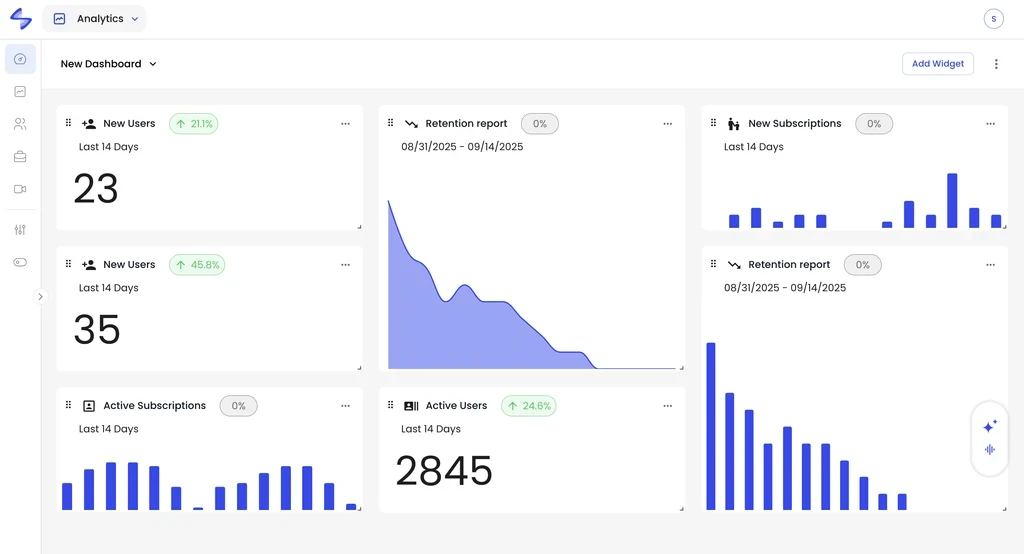
Foldspace includes product analytics Users, subscriptions and retention in the same place as intent.

  • Action
  • Navigation
  • Chat & Voice
  • Tandem
  • Generative UI
  • Kemtai
  • Vidmob
  • Metadata.io
  • RoofSnap
  • Optibus
  • AskCody
  • Base
  • Evercommerce
  • Mixmax
  • Togal.AI
  • Sustainable Minds

Users want it done, not explained.

81.5% of user requests ask agents to act, not to answer a question.
Here is what that does for the business.

4.4x
Conversion liftUsers of the agent · Mixmax
−48%
Time to paid5 days to 2.6 · Mixmax
30%
Faster onboardingFirst month on Foldspace · Base AI
+72%
Week-one engagement46% to 79% · Mixmax

Why companies choose Foldspace

01 Onboarding Agents that do the work

Where WalkMe falls short

WalkMe pioneered digital adoption for employees, with overlays that guide people through known workflows in enterprise apps, requiring the user to still do the work beyond the actions your team sets up. In the product you ship to customers, every new user has to learn the screens first.

Why Foldspace does it better

From the first session, users say what they want and Foldspace does it with the features you shipped: the setup, the configuration, the first real task. No one has to learn every screen first. The agent runs the workflows your team builds and approves, with each user's own permissions.

Business impact with Foldspace

Foldspace shortens onboarding: new users reach value in their first session instead of getting stuck in a setup guide, which accelerates time to value and brings more free-to-paid conversions and stronger retention.

02 A Product Agent to increase adoption

Where WalkMe falls short

WalkMe's AI works on top of the screens of the apps employees use: it answers from company knowledge and runs actions your team sets up, with the user approving each one. It works through the screens, not through your product's own APIs, so it isn't an agent built on your product.

Why Foldspace does it better

Foldspace is the Product Agent. Users type or speak what they want, and it knows your product and puts its features to work. The Agent Builder builds it on your product without changing your code.

Business impact with Foldspace

Foldspace grows adoption of everything you already built, without another UI redesign. Users get more value out of the product, quicker, which grows revenue and lowers churn.

03 Feed your roadmap
with real user conversations,
not just clicks

Where WalkMe falls short

WalkMe measures adoption the way IT does: app usage, workflows, forms and license use, plus the questions people ask its AI. Closing a gap in your own product still waits for new guidance or the roadmap.

Why Foldspace does it better

Foldspace covers both: classic usage and retention, plus the intent behind every request in the user's own words, whether it got done, and the product gaps users run into, ranked for your roadmap. Intent feeds your roadmap, for your team to decide. Some gaps you can close the same week with a new agentic experience, without waiting for a release.

Business impact with Foldspace

Foldspace gives you the evidence for roadmap calls you can defend: what your customers are asking for, in their own words, and how often. You ship what users already want, so each release gets adopted and fewer customers leave over a missing feature.

Foldspace vs. WalkMe
Key Capabilities Compared

What your business needs
Getting users to the outcome An agent that does the task for the user, fills in forms and shows cards and pickers in the conversation, so they get the outcome in one request In-app guidance that walks users through the steps, plus automations your team sets up
Guiding users through the product The agent navigates, acts in your web app, and can be triggered from your own buttons and backend Walkthroughs, tooltips, announcements, launchers and an in-app action bar
Understanding user behavior Product analytics with funnels, retention and session replay, captured automatically for users and the agent, with no manual event tagging Adoption analytics for app usage, workflows, forms and licenses
Understanding what users want Conversational Analytics shows what each user asked for in their own words, whether it got done, and how they felt about it Surveys, plus in-app AI questions grouped by topic
Knowing what to build next User conversations show where users get stuck, in their own words, and feed your roadmap. Product gaps and knowledge gaps show what to build or document next Usage reports and surveys show where adoption drops, for your team to turn into new guidance or roadmap items
An agent built for your product Your own Product Agent, built on your product in minutes by the Agent Builder. It answers from your content and speaks your users’ language You bring the agent for your product. WalkMe adds guidance, AI assistance and automation your team sets up, on top of your product's screens
Working with your own agents Your agents plug in over A2A and MCP. The Product Agent hands work over and brings the result back to the user Brings SAP's AI assistant into WalkMe, and routes questions to other connected assistants
Setup and developer tools One snippet and your team’s approval to go live. The Product MCP generates action-handler code in Claude, Cursor and VS Code, and agent events can flow to Mixpanel, Amplitude and Segment A JavaScript snippet or a browser extension, a mobile SDK, and an editor for content
Security and data ISO 27001 certified, SOC 2 Type II and GDPR compliant. The agent acts within each user’s own permissions, masks personal data per agent, and keeps data in US or EU data centers SOC 2, ISO 27001, FedRAMP Moderate, HIPAA and GDPR, with US, EU and other data centers


Companies add Foldspace to solve these problems

  • 80% of features in the average product are rarely or never used. Pendo Feature Adoption Report, 2019
  • 15% of product leaders say users are embracing their AI features. Pendo survey, 2024
  • 49% of product teams lack time for strategic planning, roadmap development or data analysis. Atlassian, State of Product 2026
  • 46% of product managers name resource limits as the top barrier to experimentation. CleverTap, Dec 2024
“Foldspace AI helps us accelerate the shift towards an agentic product experience. With their platform, we've been able to leapfrog to the future of SaaS UX.”
Allan Mørch, CEO, AskCody Allan MørchCEO, AskCody

Already building your own agent?

Your team's edge is your domain. Spend it there.

Build the brain, buy the operator.
Foldspace is the operator.

Already built your own chat UI?
Keep it and run Foldspace behind it.

Your users

The operator

Foldspace runs it

  • Chat and voice
  • Actions in your product
  • Agentic UI
  • Each user's permissions
  • Analytics on every request
The brain

Your domain expertise

  • Your agents
  • Your back-end workflows
  • Your data and logic
  • Your industry know-how

Book a demo

See Foldspace on your product.

  • No re-platform. The agent sits on your existing front end and back end.
  • One snippet. Going live is one snippet and your team's approval.
  • Nothing new to learn. Users ask, and the agent does the task.
  • Plugs into your analytics. Agent events can flow to Mixpanel or Amplitude.
Security

Enterprise grade compliance

ISO 27001 Information Security AICPA SOC 2 GDPR
Visit our Trust Center →

Frequently asked questions

Is Foldspace a WalkMe alternative?

For the product you ship to customers, it can be an alternative or an add-on, and the choice is yours. You can keep WalkMe and add Foldspace for the work users still do by hand. If guidance in your own product is the main thing you use WalkMe for, you can move that job to the agent when your contract comes up for renewal. Run both side by side first, then decide.

What is the difference between Foldspace and WalkMe?

Foldspace works for your users inside your product. Users say what they want, and it does it in the live product: it runs actions through your product's own APIs, navigates, answers from your product's knowledge and shows agentic UI in the conversation, within each user's own permissions. WalkMe, which SAP acquired in 2024, is a digital adoption platform built mainly for employees working across enterprise apps, with in-app guidance, an AI assistant, adoption analytics and workflow automation.

Is Foldspace a digital adoption platform?

Foldspace has the same goal as a digital adoption platform: getting users to the outcomes your product was built for. The approach is different. Digital adoption platforms such as WalkMe mainly guide users through the interface with in-app guidance, plus automation your team sets up. The Product Agent skips the lesson. Users say what they want, and it does the task inside your live product.

Can WalkMe be used for customer-facing products?

WalkMe offers a customer-facing plan, but it is built mainly for employee apps such as Salesforce and Workday, and it sells separate offers for employee and customer use. Foldspace is built for the product you ship to customers: users ask, the agent does the task, and your team sees what they asked for.

Can I use Foldspace and WalkMe together?

Yes. If you use WalkMe for the employee apps you roll out to staff, keep it there, and add Foldspace to the product you ship to customers. Foldspace sits on your existing front end and back end. There is no direct data connection between WalkMe and Foldspace today, and your history stays in WalkMe. Running both side by side lets you compare on your own numbers.

What happens to the walkthroughs we already run in WalkMe?

The Product Agent does the task when users ask, so no one needs a walkthrough to get there. You decide if and when a walkthrough moves to the agent.

Who builds and maintains it? We have no engineering time.

The Agent Builder builds it without changing your product's code. Going live is one snippet and your team's approval. After that, PMs adjust instructions and conversation starters themselves. A multi-product platform added the Product Agent across 3 products in 1 sprint, with 1 engineer on their side.

WalkMe has AI and automation. Isn't that the same as Foldspace?

They overlap, but they work differently. WalkMe's AI answers from company knowledge and runs actions your team sets up, through the app's screens, with the user approving each one. Foldspace starts from what users ask in their own words, picks from the actions your team built and approved, and runs them through your product's own APIs within each user's own permissions.

Does Foldspace include product analytics?

Yes. Product analytics is included. Conversational Analytics adds the intent behind each request in the user's own words, with sentiment, outcomes and gaps. It reads conversations with the Product Agent, so it starts once the agent is live. Agent events can also flow to Mixpanel or Amplitude.

How is Foldspace priced?

Foldspace starts with a 30 day free trial and is priced per product. See current plans on the pricing page.

How long does it take to build the agent?

The Agent Builder builds a working Product Agent on your own product in minutes, with no changes to your product's code. Minutes is the build, not production: going live is one snippet and your team's approval.

Is it safe to let an agent act in my product?

The agent acts under each signed-in user's own permissions and token, so it can't do anything the user can't. It works from the actions and knowledge you give it, and the Agent Builder asks before publishing anything. Going live is one snippet and your team's approval.

What does WalkMe do that Foldspace doesn't?

Foldspace is for the software you build and ship to customers. It doesn't cover employee adoption of third-party apps such as SAP, Salesforce and Workday, desktop apps, government deployments such as FedRAMP, or native mobile apps. If you rely on WalkMe for those, keep it for them.