Skip to content

Foldspace vs. ChatbotsAnswers plus actions

Chatbots answer questions. Foldspace answers and does the work.

Your chatbot answers questions from your help content.Foldspace answers them too, then does the task in one request.

Foldspace does the task inside your product Users ask, and the Product Agent runs it in your app with the features you shipped.

  • Action
  • Navigation
  • Chat & Voice
  • Tandem
  • Generative UI
  • Kemtai
  • Vidmob
  • Metadata.io
  • RoofSnap
  • Optibus
  • AskCody
  • Base
  • Evercommerce
  • Mixmax
  • Togal.AI
  • Sustainable Minds

Users want it done, not explained.

81.5% of user requests ask agents to act, not to answer a question.
Here is what that does for the business.

4.4x
Conversion liftUsers of the agent · Mixmax
−48%
Time to paid5 days to 2.6 · Mixmax
30%
Faster onboardingFirst month on Foldspace · Base AI
+72%
Week-one engagement46% to 79% · Mixmax

Why companies choose Foldspace

01 Onboarding Agents that do the work

Where chatbots fall short

A chatbot built on your help content answers questions about setup, often with a link to the right article. The new user still goes to the screen and does the work, one step at a time.

Why Foldspace does it better

From the first session, users say what they want and Foldspace does it with the features you shipped: the setup, the configuration, the first real task. No one has to learn every screen first. The agent runs the workflows your team builds and approves, with each user's own permissions.

Business impact with Foldspace

Foldspace shortens onboarding: new users reach value in their first session instead of getting stuck in a setup guide, which accelerates time to value and brings more free-to-paid conversions and stronger retention.

02 A Product Agent to increase adoption

Where chatbots fall short

A chatbot can tell users a feature exists and where to find it. Adoption still depends on each user going there and doing it themselves.

Why Foldspace does it better

Foldspace is the Product Agent. Users type or speak what they want, and it knows your product and puts its features to work. The Agent Builder builds it on your product without changing your code.

Business impact with Foldspace

Foldspace grows adoption of everything you already built, without another UI redesign. Users get more value out of the product, quicker, which grows revenue and lowers churn.

03 Feed your roadmap
with real user conversations,
not just clicks

Where chatbots fall short

Most chatbot reports show conversation volume, resolution and the topics users asked about. They stop at the conversation, so they don't show whether the task got done in your product.

Why Foldspace does it better

Foldspace covers both: classic usage and retention, plus the intent behind every request in the user's own words, whether it got done, and the product gaps users run into, ranked for your roadmap. Intent feeds your roadmap, for your team to decide. Some gaps you can close the same week with a new agentic experience, without waiting for a release.

Business impact with Foldspace

Foldspace gives you the evidence for roadmap calls you can defend: what your customers are asking for, in their own words, and how often. You ship what users already want, so each release gets adopted and fewer customers leave over a missing feature.

Foldspace vs. Chatbots
Key Capabilities Compared

What your business needs Foldspace Chatbots
Getting users to the outcome An agent that does the task for the user, fills in forms and shows cards and pickers in the conversation, so they get the outcome in one request Answers the question and links to a help article, and the user does the task
Guiding users through the product The agent navigates, acts in your web app, and can be triggered from your own buttons and backend Explains the steps in text and links to the right page or article
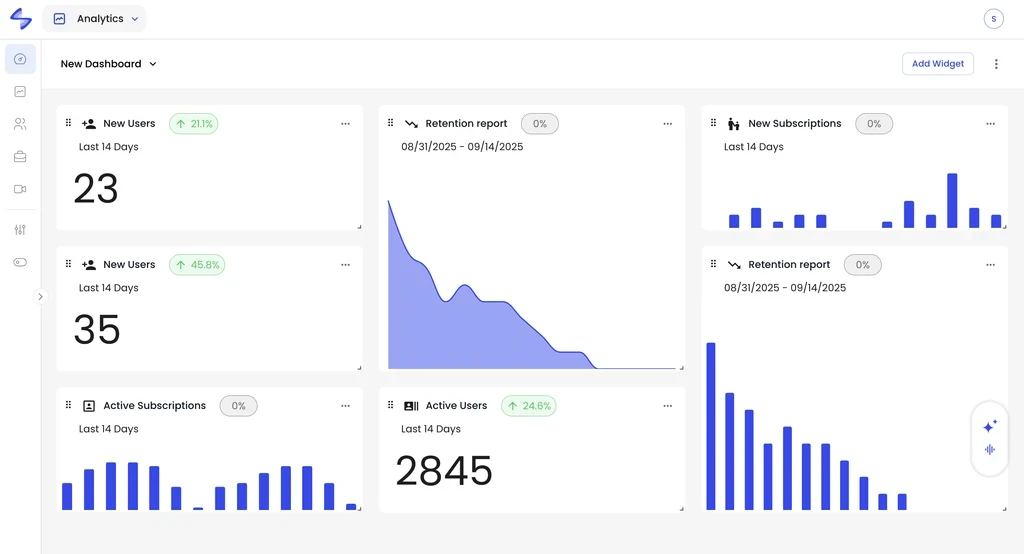
Understanding user behavior Product analytics with funnels, retention and session replay, captured automatically for users and the agent, with no manual event tagging Conversation counts and ratings, separate from your product analytics
Understanding what users want Conversational Analytics shows what each user asked for in their own words, whether it got done, and how they felt about it Questions and topics from chat, without what users then did in the product
Knowing what to build next User conversations show where users get stuck, in their own words, and feed your roadmap. Product gaps and knowledge gaps show what to build or document next Unanswered questions show gaps in your help content
An agent built for your product Your own Product Agent, built on your product in minutes by the Agent Builder. It answers from your content and speaks your users’ language A chatbot set up on your help content, often from your support platform
Working with your own agents Your agents plug in over A2A and MCP. The Product Agent hands work over and brings the result back to the user Hands off to a person in your support inbox. Connecting your own agents depends on the vendor
Setup and developer tools One snippet and your team’s approval to go live. The Product MCP generates action-handler code in Claude, Cursor and VS Code, and agent events can flow to Mixpanel, Amplitude and Segment A snippet and your help-center content
Security and data ISO 27001 certified, SOC 2 Type II and GDPR compliant. The agent acts within each user’s own permissions, masks personal data per agent, and keeps data in US or EU data centers Depends on the vendor


Companies add Foldspace to solve these problems

  • 80% of features in the average product are rarely or never used. Pendo Feature Adoption Report, 2019
  • 15% of product leaders say users are embracing their AI features. Pendo survey, 2024
  • 49% of product teams lack time for strategic planning, roadmap development or data analysis. Atlassian, State of Product 2026
  • 46% of product managers name resource limits as the top barrier to experimentation. CleverTap, Dec 2024
“Foldspace AI helps us accelerate the shift towards an agentic product experience. With their platform, we've been able to leapfrog to the future of SaaS UX.”
Allan Mørch, CEO, AskCody Allan MørchCEO, AskCody

Already building your own agent?

Your team's edge is your domain. Spend it there.

Build the brain, buy the operator.
Foldspace is the operator.

Already built your own chat UI?
Keep it and run Foldspace behind it.

Your users

The operator

Foldspace runs it

  • Chat and voice
  • Actions in your product
  • Agentic UI
  • Each user's permissions
  • Analytics on every request
The brain

Your domain expertise

  • Your agents
  • Your back-end workflows
  • Your data and logic
  • Your industry know-how

Book a demo

See Foldspace on your product.

  • No re-platform. The agent sits on your existing front end and back end.
  • One snippet. Going live is one snippet and your team's approval.
  • Nothing new to learn. Users ask, and the agent does the task.
  • Plugs into your analytics. Agent events can flow to Mixpanel or Amplitude.
Security

Enterprise grade compliance

ISO 27001 Information Security AICPA SOC 2 GDPR
Visit our Trust Center →

Frequently asked questions

Is Foldspace a chatbot?

No. A chatbot answers. The Product Agent acts. Foldspace works for your users inside your product. Users say what they want, and it does it in the live product: it runs actions through your product's own APIs, navigates, answers from your product's knowledge and shows agentic UI in the conversation, within each user's own permissions.

What is the difference between Foldspace and a chatbot?

A chatbot built on your help content answers questions, and the user still goes and does the task. Foldspace does the task for them, inside your product, and shows the result as cards, forms and pickers in the conversation. It acts under each signed-in user's own permissions and token, so it can't do anything the user can't.

Can Foldspace answer questions too?

Yes. It answers from your product's knowledge, and when the request is a task, it does the task. Requests it can't handle yet show up as gaps in Conversational Analytics, so your team knows what to add next.

Can I use Foldspace next to the chatbot we already have?

Yes. Your chatbot keeps answering help-center questions, and Foldspace works inside your product on the tasks users came to do. It sits on your existing front end and back end.

We already have a chatbot. Why add Foldspace?

Many in-product assistants get tried once and fade, because users aren't sure what to ask and the assistant can explain more than it can do. Foldspace does the task, inside your product, within each user's own permissions.

Who builds and maintains it? We have no engineering time.

The Agent Builder builds it without changing your product's code. Going live is one snippet and your team's approval. After that, PMs adjust instructions and conversation starters themselves. A multi-product platform added the Product Agent across 3 products in 1 sprint, with 1 engineer on their side.

Isn't a chatbot's conversation report the same as Conversational Analytics?

Not quite. Chatbot reports show conversations, resolution and topics. Conversational Analytics shows the intent behind each request in the user's own words, whether Foldspace got it done, and the product gaps that feed your roadmap.

Does Foldspace include product analytics?

Yes. Product analytics is included. Conversational Analytics adds the intent behind each request in the user's own words, with sentiment, outcomes and gaps. It reads conversations with the Product Agent, so it starts once the agent is live. Agent events can also flow to Mixpanel or Amplitude.

How is Foldspace priced?

Foldspace starts with a 30 day free trial and is priced per product. See current plans on the pricing page.

How long does it take to build the agent?

The Agent Builder builds a working Product Agent on your own product in minutes, with no changes to your product's code. Minutes is the build, not production: going live is one snippet and your team's approval.

Is it safe to let an agent act in my product?

The agent acts under each signed-in user's own permissions and token, so it can't do anything the user can't. It works from the actions and knowledge you give it, and the Agent Builder asks before publishing anything. Going live is one snippet and your team's approval.

What does a chatbot do that Foldspace doesn't?

Support chatbots often run across channels outside your product, such as your website, email and messaging apps, and some also run support tasks through your helpdesk. Foldspace is for the work users do inside the software you build and ship to customers. If you rely on a chatbot for those channels, keep it for them.